An official document translation in Australia is a full English translation done by a translator holding a valid NAATI credential, who certifies it with their name, stamp and a certification statement. Most government agencies, universities and regulators expect exactly that. A plain English version, or one produced by a free online tool, usually will not be accepted. This guide explains what makes a translation acceptable, which details it must carry, where errors creep in and what to do if one slips through.
TL;DR
- For official use in Australia, the translator must hold a relevant NAATI credential and certify the translation with their name, stamp and statement.
- Translate the whole document, following the original layout as closely as possible, including stamps, seals and handwritten notes.
- Most errors that cause trouble are small: misspelt names, wrong dates, mistyped numbers. Check these yourself before you submit.
- If you spot a mistake after delivery, tell the translator straight away, naming the page and the detail, and do not edit the issued file yourself.
- We provide NAATI-certified translation in over 170 languages. Certified translation starts from $0.12 per word.
Table of Contents
- What official document translation means in Australia
- What a certified translation must carry
- Who asks for a certified translation
- Documents that commonly need official translation
- Preparing your original document
- The errors that cause trouble
- How to check a translation before you submit
- If you find an error after delivery
- Our certified translation service
- FAQ
What official document translation means in Australia
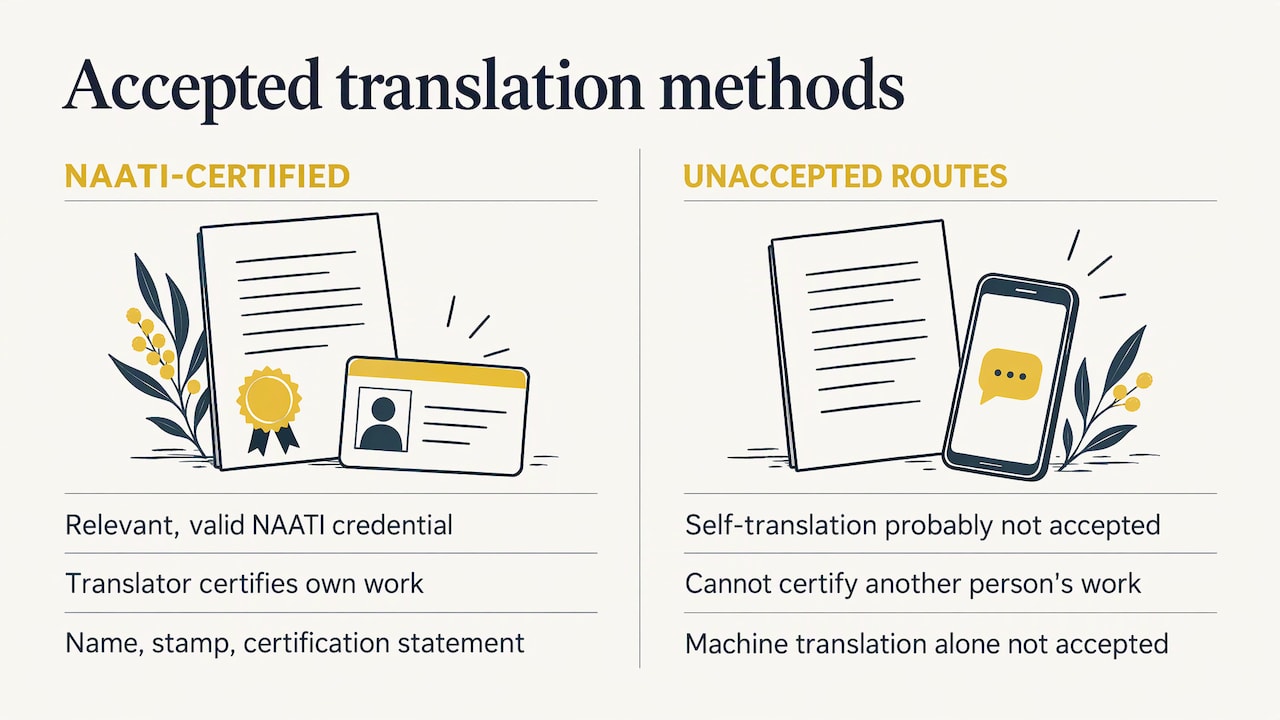
The word ‘official’ covers any translation that a government body, court, university, employer or professional board will rely on. In Australia, the practical test is who did the work. According to the AUSIT style guide for official and legal documents, a certified translation is one undertaken by a translator who has been awarded a relevant and valid NAATI credential, and who has certified it by adding their name, stamp and certification statement.
NAATI is the national standards and certification body for translators and interpreters. It does not translate anything itself. Its FAQ explains that it licenses people who wish to work as translators or interpreters, and that most government agencies in Australia require documents to be translated by someone with NAATI certification where that is available in the language.
Two points catch people out.
A translation cannot be certified by someone else. AUSIT’s guidance for personal documents says that unless the original translator is certified or recognised by NAATI, the translation probably won’t be accepted. It also says that, for reasons of professional ethics, a translator in Australia can’t certify a translation done by another person. So you cannot translate it yourself, or have a friend do it, and then pay someone to stamp it.
Machine translation is not accepted on its own. The Australian Embassy in Brazil, publishing Department of Home Affairs requirements, states that translations done in Australia must be by a NAATI-accredited translator. It adds that the Department will not accept inaccurate or poor-quality work, such as that from free online tools like Google Translate.
The same page notes that when there is doubt about whether a document needs a sworn translation or just an accurate one, a sworn translation should be provided. For overseas-issued requirements, always read what the receiving authority asks for.
What a certified translation must carry
Authorities look for particular marks on the page. Missing one can mean a rejected file and a lost week or more.
The translator’s details and stamp
The Australian Government Language Services Guidelines state that NAATI-credentialed translators must certify that their translation is true and accurate to the best of their knowledge. They must also affix their personal NAATI-issued stamp, name, credential details, language direction, date and signature to the translated product.
The stamp can be physical or digital. The AUSIT guide says there are two types of NAATI stamp in use, the digital stamp and the physical stamp, and that both are equally valid.
A certification statement
AUSIT recommends putting a certification statement at the bottom of each page of the translation. The wording runs along these lines: the translator, with their full name and certification details, certifies that this is a true and accurate translation, to the best of their skill and ability, of the source-language text in the attached document, naming the type of document.
Every page, complete
Universities are often explicit. The Australian National University says a document in another language must come with a complete English translation, and that each page of an authorised translation must show the translator’s signature, the date translated, their accreditation details and the official stamp or seal. A summary will not do.
Matching layout
The AUSIT guide says a full translation should follow the source document’s format and layout as closely as possible. In practice this means the reviewer can hold the original and the translation side by side and find each field, stamp and signature in the same place. Seals, watermarks and handwritten annotations are described in square brackets, for example [round seal of the registry office].
Who asks for a certified translation
Requirements differ by body, but the pattern is consistent.
| Body | What it says | Source |
|---|---|---|
| ASIC | A non-English document lodged with ASIC needs a certified English translation, and one made in Australia must be certified by a NAATI professional certified translator | ASIC |
| Australian Passport Office | Documents not in English must be translated in full and stamped by an accredited translator | Passport Office |
| Universities | A complete English translation with the translator’s signature, date, accreditation details and stamp on every page | ANU |
| Visa applications | Translation by a NAATI-accredited translator if completed in Australia | Home Affairs requirements |
The Passport Office adds that translations from certain government agencies that use NAATI translators are accepted on the agency’s letterhead.
Who pays? AUSIT’s guidance says it is the applicant’s responsibility to arrange the translation before submitting an application or attending an interview, and in most cases the applicant pays for it themselves. Plan for that in your timeline, not the day before a deadline.
If you need translation for a court matter, the requirements are tighter again. Our guides on court document translation and affidavit translation cover what courts typically look for.
Documents that commonly need official translation
The usual list for visas, study, work and legal matters includes:
- Birth, marriage and death certificates
- Divorce decrees and name-change records
- Passports and national identity cards
- Driver licences
- Academic transcripts, degrees and diplomas
- Police clearances
- Court orders, affidavits and powers of attorney
- Company registration documents and contracts
Not every supporting paper needs translating. The Home Affairs requirements page linked above says bank statements and annual income tax declarations, where the information is clear, do not need to be translated. Check the checklist of the specific application, because this varies by visa and by agency.
For a broader walk-through of the process, see our practical guide to NAATI document translation. If you are based in Victoria, our page on NAATI translation services in Melbourne covers the local side.
Preparing your original document
Good preparation prevents most of the errors discussed below.
- Scan every page, including the back. Stamps, endorsements and notes on the reverse are part of the document.
- Use a sharp, flat, full-colour scan. Cropped corners or shadowed edges hide digits and seals. A photo taken at an angle is a common cause of misread numbers.
- Tell the translator the purpose. A visa file, a university enrolment and a court filing can each have different expectations. Name the receiving body.
- Give the correct spelling of names in Latin script. Use the form that appears in your passport. If a name has been romanised differently across documents, say so up front so the translator can keep it consistent.
- Flag the date format. A date like 03/04/2020 can be 3 April or 4 March depending on the country. Ask the translator to write dates unambiguously, for example 3 April 2020.
- Send supporting records. Where documents relate to each other, such as a marriage certificate and a name-change record, send them together so details match.
The errors that cause trouble
When people worry about translation errors they picture a mistranslated sentence. In official documents the trouble is more often a small detail.
Researchers Taibi and Ozolins, in a 2022 study of the quality and integrity of translated personal documents, note that even work of an otherwise high standard can contain errors or omissions in the transcription or annotation of holder details, numerals and other document particulars. These may look minor in terms of language, but can cause major inconvenience or risk for clients and institutions. The same study found that in sample translations from Chinese, Spanish and Arabic marked below 70% by the harshest examiner, the areas needing improvement included completeness, accuracy, language and the description of official features.
The errors worth hunting for are:
- Names. Misspelt, transposed given and family names, or inconsistent romanisation across documents.
- Dates and numbers. Day and month swapped, a digit dropped, an ID or certificate number mistyped.
- Omissions. A stamp, seal, margin note or reverse page left out.
- Layout drift. Fields moved or merged, so the reviewer cannot match the translation to the original.
- Missing certification. No stamp, no statement, or the statement only on the last page.
- Wrong credential. The translator is not NAATI-certified for that language, or the translation was certified by someone who did not do it.
How errors affect your application
A mismatch can lead the receiving body to ask for more. For a visa, that is typically a Request for Further Information. One migration consultancy explains that an RFI comes with a strict deadline, commonly 28 days, that it pauses the clock on the application, and that missing the deadline can lead to a decision on the information already provided, or a refusal. Delays can run from a few weeks to several months. A corrected translation sent promptly is far cheaper than that.
How to check a translation before you submit
You do not need to read the target language to catch most problems. The NAATI Online Directory’s guide to reviewing translations lists basic checks anyone can do:
- Compare the text length of the original and the translation.
- Check formatting: paragraphs, bullet points, headings.
- Verify that numbers and symbols match the original.
- Look for typing errors.
It also advises getting a second translator to review the work if something feels wrong, and always doing so for legal documents, health information and anything that requires precision.
Add these checks specific to official papers:
- Put the original and the translation side by side and tick each field: name, date of birth, place, document number, issue date, issuing authority.
- Confirm the name matches your passport exactly.
- Check every page carries the stamp or certification statement.
- Check that each seal and handwritten note in the original has a bracketed description in the translation.
- Check the file is complete: the page count should match the original plus any certification page.
Government procurement guidance sets a higher bar that is useful as a benchmark. The Outline of Procedures for Australian Government Agencies says the final product should be proofed for misspellings, with the layout matching the source, fonts correct, headers and footers consistent, names spelt correctly and pagination right. It also suggests considering back-translation for quality assurance. The Language Services Guidelines describe revision (a bilingual comparison of the translation with the source), review (a monolingual read of the target text) and back-translation. They add that, time and budget permitting, it is preferable for a second NAATI-credentialed translator to revise the work independently, and that back-translation suits complex, technical or legally significant material.
For a birth certificate you will not need all of that. For a contract, a court document or a patent, ask about a second-translator review when you request a quote. Our guide to patent translation shows how this works on technical text.
If you find an error after delivery
Act quickly and keep a record.
- Identify the page and the exact detail. Write down what the translation says and what the original says.
- Send it to the translator in writing. Ask them to check it against the source. A professional translator will correct a genuine error and reissue the certified file.
- Do not edit the issued file yourself. Changing a certified document, even to fix a typo, voids the certification.
- Compare the replacement. Check the whole document again, not just the corrected line, and make sure the right version is in your upload folder. This process is outlined in a Wise Kangaroo checklist.
- If the original is wrong, ask the issuing authority about its correction process. A translation cannot establish a fact that differs from the source record.
If your translation came through a government service, check its correction window. For example, TIS National says you must report mistakes in a document it translated within 30 days of receiving it, and that if the request is approved the correction is made free within 7 days.
If you have already lodged the translation, tell the receiving body what has changed and provide the corrected version, rather than hoping nobody notices.
Our certified translation service
We have provided translation since 2000, in over 170 languages, with NAATI-certified translation for documents that must be accepted by Australian authorities. Our work covers personal, immigration, legal, academic, business and medical documents, handled in confidence.
Published rates start at $0.12 per word for certified translation and $0.08 per word for standard translation, which suits material that does not need certification. Our certified and NAATI translation page has the details. Urgent work and certification can carry extra charges, so tell us your deadline when you send the file.
Send us the scan, name the receiving body and tell us when you need it. We will confirm what the document requires before you pay. You can start from our homepage.
FAQ
Can I translate my own documents for a visa application?
No, not for official use. AUSIT’s guidance says official purposes require a translator certified or recognised by NAATI, and the Home Affairs requirements reject poor-quality translations such as free online tool output. Use a NAATI-credentialed translator for the final version.
Does every page need a stamp?
It is safest if it does. ANU requires each page of an authorised translation to carry the translator’s signature, date, accreditation details and stamp or seal, and AUSIT recommends a certification statement at the bottom of each page. Check what your receiving body asks for.
Is a digital NAATI stamp valid?
Yes. AUSIT’s style guide says the digital and physical NAATI stamps are both in use and equally valid. Some bodies prefer a particular format for lodgement, so confirm that on the application page.
What should I do if my translation has a spelling mistake in a name?
Contact the translator immediately with the page and detail, and ask them to check against the source. Do not alter the file yourself. If you have already lodged it, send the corrected version to the receiving body as soon as you have it.
Which documents do not need translating?
It depends on the application. Home Affairs guidance says bank statements and annual income tax declarations do not need translating where the information is clear. Always check the checklist for your visa, course or filing.