
A NAATI document translation is an English translation (or a translation into another language) done by a translator who holds current certification from NAATI, the national standards and certifying authority for translators and interpreters in Australia. Visa applications, study, work and legal matters often call for one. This guide explains what the term means, what a compliant translation shows, how to prepare your documents and what to do if an organisation pushes back.
TL;DR
- NAATI certifies individual translators. It does not translate documents itself, so you hire a certified practitioner or a company that works with them.
- The receiving organisation (Home Affairs, a university, a court, a licensing body) decides whether you need a certified translation. Ask it before you order.
- A compliant translation carries the translator’s NAATI stamp, practitioner ID, language, certification type, name, date and signature on every page.
- You can check any translator’s credential in NAATI’s public online directory.
- At Stellar Translations, certified translation starts from $0.12 per word and standard translation from $0.08 per word.
Table of Contents
- What NAATI certified document translation actually means
- Which documents usually need a certified translation
- What a compliant NAATI translation must show
- How to prepare your documents for translation
- What certified translation costs
- Free translation for new arrivals
- Perspective
- Order a NAATI-certified translation with Stellar
- When an organisation will not accept your translation
- Choosing a provider: a short checklist
- FAQ
- Sources
What NAATI certified document translation actually means
NAATI is the body that sets the standard. NAATI is the national standards and certifying authority for translators and interpreters in Australia, and holding its certification confirms a practitioner meets the professional standard expected for translating documents. Credentials must be renewed through recertification every three years.
The detail that trips people up: NAATI licenses practitioners but does not provide translation services. There is no NAATI counter where you hand over a birth certificate. You work with a certified translator directly, or with a translation company whose certified translators do the work.
So “NAATI document translation” really describes three things together:
- A qualified person: the translator holds a current NAATI credential for that language pair.
- A formal output: the translation is stamped and signed in the way NAATI and receiving bodies expect.
- A traceable record: anyone can confirm the credential.
A standard translation, by contrast, may be perfectly accurate and useful for understanding a document, but it does not carry that credential. It suits internal business use, research, or checking what a foreign document says before you commit to the certified version.
Which documents usually need a certified translation
There is no single national list. Whether you need a NAATI-certified translation depends on who will read the document and why. The decision sits with the receiving organisation, not with the translator and not with you. A visa case officer, a university admissions office, a professional registration board, a court registry and a state licensing authority can each have their own rules.
In practice, the documents most often sent for certified translation fall into these groups:
- Identity and civil documents: passports, birth certificates, marriage certificates, divorce decrees, name-change records, national ID cards.
- Education records: degrees, academic transcripts, certificates of completion, course descriptions.
- Employment and financial documents: reference letters, contracts, payslips, tax records, bank statements.
- Legal documents: court orders, powers of attorney, wills, affidavits, contracts, property documents.
- Medical and police records: medical reports, vaccination records, police clearances.
A useful rule: if a document is evidence for an official decision, assume the decision-maker will want a certified translation, then confirm in writing. Home Affairs, for example, states on its forms that non-English documents must come with certified English translations, and that copies of originals must be stamped or authorised as true copies on each page. That wording appears on the Australian Declaratory visa application, and other forms have their own checklists, so read the one that applies to you.
For academic and professional bodies, check the requirements page or email the admissions or registration team. Ask three things: do you need NAATI specifically, do you need the translation of the whole document or only certain parts, and do you need the original, a certified copy or a scan.
What a compliant NAATI translation must show
A translation can be accurate and still get rejected because it is missing the formal elements. The clearest published checklist comes from the Department of Foreign Affairs and Trade. DFAT requires the translator’s NAATI stamp, practitioner ID, language and certification type, name, date, and signature or digital authentication on every page. Other organisations typically look for the same core elements, so using this as your benchmark is sensible.
A few points worth knowing:
- Every page, not just the last. Check that each page of the translation carries the stamp and signature, including pages that are mostly seals or handwritten notes.
- Current credentials. Since 1 July 2018, DFAT has accepted translations by translators holding NAATI credentials under the current Certification System, including Recognised Practising credentials. Older credential types do not meet that rule.
- Digital stamps. NAATI released digital stamps in March 2023 carrying QR codes that let a reader verify the credential. Some organisations may not accept them, which is covered below.
- Validity. A translation by a NAATI-certified translator remains valid indefinitely, as long as the translator held active certification when the work was completed. Translators’ credentials expire and get renewed, but the date on your translation is what counts. Even so, a few organisations ask for a translation completed within a recent window, so confirm with yours.
How to check a translator’s credential
You do not have to take anyone’s word. The public can use NAATI’s online directory to check whether a translator is currently certified. Search the practitioner ID printed on the stamp and confirm the name and language pair match. If you use a company, ask which certified translator will sign your document and check that person.
How to prepare your documents for translation
Good preparation prevents most delays. Work through this list before you send anything.
- Ask the receiving body what it needs. Certified or not, NAATI or not, which pages, what format.
- Gather every page. Include reverse sides, stamps, seals, endorsements and handwritten notes. A translator translates what is on the page, and a missing back page can mean a rejected set.
- Scan clearly. Use a flat, well-lit, high-resolution scan or a clean photo with all four corners visible. Illegible text slows the work and forces the translator to mark passages as unclear.
- Confirm name spellings. Your name in the translation should match the spelling in your passport. If your documents show different transliterations, tell the translator which spelling to use and have supporting evidence ready. Inconsistent names across documents are a common source of questions from case officers.
- Say where the document is going. A translator can format and certify to suit the purpose, whether that is a visa, a university application or a court filing.
- Keep originals safe. For most jobs a good scan is enough to start. Certified copies of originals are a separate step from translation.
If an original is already in English, it does not need translating. If it is partly in English and partly in another language, translate the foreign parts and tell the translator which sections are already English.
What certified translation costs
Pricing models vary: per page, per word, or by document type, with extra charges for certification or speed. Per-word pricing is the most transparent for long or text-heavy documents, because you pay for the content rather than a flat page rate that assumes a certain density.
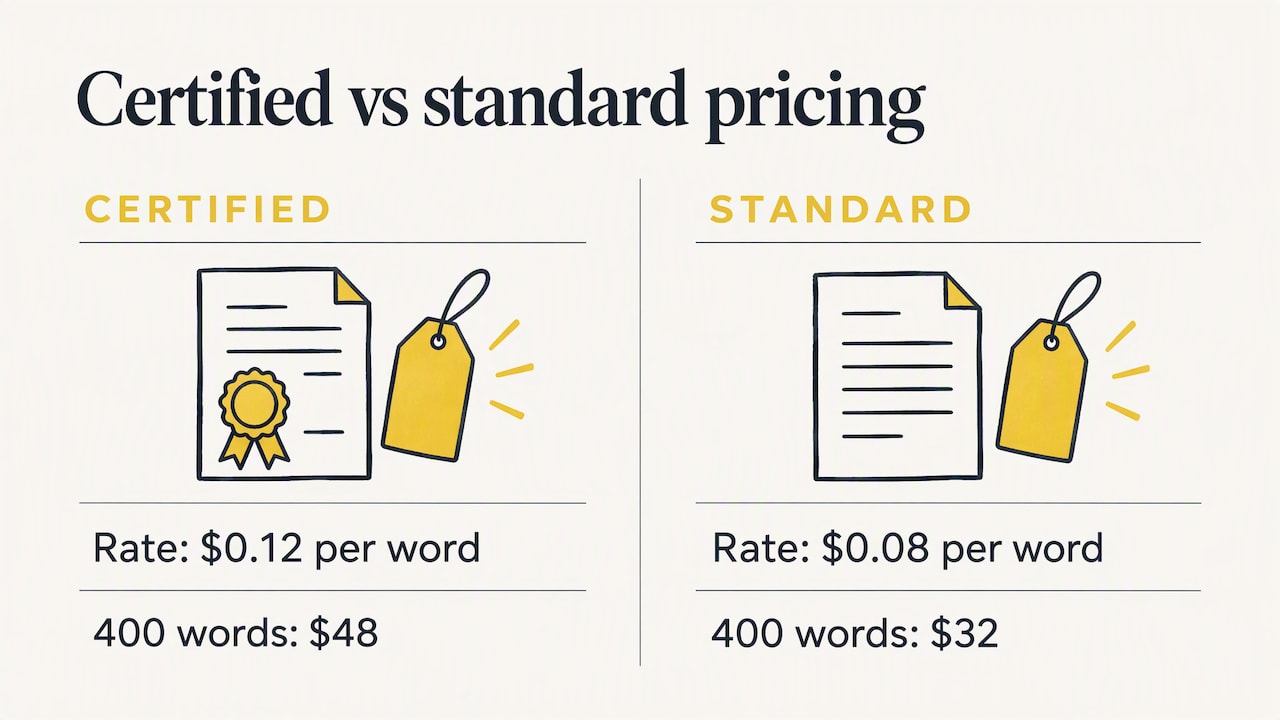
At Stellar Translations, certified translation starts from $0.12 per word and standard translation from $0.08 per word. Urgent work and some specialist subjects carry additional charges, so send the document for a quote before you commit. As a rough illustration only, a 400-word document at the starting certified rate works out to $48 before any extras, and the same document at the starting standard rate to $32. Your actual quote depends on language pair, layout, subject and turnaround.
When you compare quotes, compare like with like: is the translation certified by a NAATI-credentialed translator, is every page stamped, is the digital or paper format accepted by your receiving body, and are revisions included if a name or date needs correcting?
Free translation for new arrivals
Some people do not need to pay at all. Eligible permanent residents and select temporary or provisional visa holders can use Australia’s Free Translating Service for up to 10 documents, available within the first two years of the eligible visa grant date. It is designed to help people settling in translate documents into English for purposes such as work, study and community life.
Check the Home Affairs page for the current list of eligible visas and what the service covers. If you fall outside it, or you need a translation for something other than settlement, or for a document going overseas, a paid certified translation is the route.
Perspective
Most rejected translations we see are not wrong translations. They are translations that do not match what the receiving body expected: a missing stamp on one page, a name spelled differently from the passport, or a standard translation sent where a certified one was needed.
That is why we treat NAATI certification as part of the job rather than an add-on. Our NAATI-certified service is built around the official requirements for documentation in Australia, and our translators work across more than 170 languages, with particular depth in legal and technical material. We have been doing this since 2000, and the lesson has been consistent: when the credential, the formatting and the accuracy are right the first time, applications move forward.
Our advice is simple. Ask the organisation what it needs, send complete and clear scans, and use a certified translator you can verify. We keep documents confidential and offer fast turnaround options when a deadline is close.
Matthew
Order a NAATI-certified translation with Stellar
If you already know what the receiving body needs, our team can handle the translation from scan to stamped delivery. We translate personal, immigration, academic, legal, business and medical documents, and we are based in Melbourne while serving clients across Australia. Certified translation starts from $0.12 per word. See our NAATI-certified translation options for details, or send your document for a quote.
For court material, contracts and other high-stakes paperwork, our legal translation service is staffed by translators with specialist experience. Health records go through our medical translation team.
When an organisation will not accept your translation
Sometimes a perfectly valid translation is questioned. The most common cause is the digital stamp. NAATI introduced digital stamps and IDs to improve security and reduce document fraud, and to fix practical problems with paper workflows, according to NAATI’s own explanation of the change. Staff at some organisations are still getting used to them.
If that happens, work through these steps:
- Show the verification. The QR code on the digital stamp lets the reader confirm the credential, and you can point them to NAATI’s public directory.
- Provide the NAATI Practitioner Identification brochure. NAATI advises giving this brochure to an organisation that will not accept a digital stamp.
- Give NAATI feedback if it still refuses. Include the organisation’s contact details where you can, so NAATI can contact it directly.
- Ask whether a paper-stamped version is accepted. If a deadline is close, a different format may be the quickest fix. Tell your translator what the organisation will take.
- Raise the validity point if age is the issue. NAATI’s position is that a certified translation is tied to the date it was completed. If the translator was certified on that date, the translation’s validity does not depend on a later expiry of their credential.
Keep a written record of the refusal and what the organisation said it needed. It makes any correction faster.
Choosing a provider: a short checklist
- The translator’s NAATI credential is current and covers your language pair, and you can verify it.
- The company tells you who will sign the translation.
- Every page will carry the required stamp, ID, date and signature.
- Quotes state the per-word or per-page rate, certification, urgency charges and revisions.
- Confidentiality is stated clearly, which matters for identity, medical and financial records.
- The provider will format the translation to suit your receiving body.
FAQ
Does NAATI translate my documents?
No. NAATI certifies translators and interpreters but does not provide translation services. You engage a NAATI-certified translator directly or through a translation company. You can then confirm the credential in NAATI’s online directory.
Do I always need a NAATI-certified translation?
No. The organisation receiving your document decides. Visa applications to Home Affairs commonly require certified English translations of non-English documents, while an internal business use may only need a standard translation. Check the instructions on your form or ask the organisation before you order.
How long is a NAATI translation valid?
A translation by a NAATI-certified translator remains valid indefinitely, provided the translator held active certification when the work was completed. Some organisations still ask for recent documents, so confirm their rule if your translation is old.
Can I get my documents translated for free?
Possibly. Eligible permanent residents and select temporary or provisional visa holders can use the Free Translating Service for up to 10 documents within two years of their eligible visa grant. Check the Home Affairs page to see whether your visa qualifies.
What if my digital stamp is rejected?
Show the QR verification, give the organisation NAATI’s Practitioner Identification brochure, and report the refusal to NAATI if it persists. Also ask your translator whether a different format would be accepted.
Sources
- NAATI Certification System
- Frequently Asked Questions, NAATI
- DFAT Requirements for Translators, NAATI
- NAATI Practitioner Identification
- Check a NAATI certification, NAATI Online Directory
- NAATI Translator Stamp Information
- NAATI Digital Stamp and ID
- Form 931, Application for an Australian Declaratory visa
- Free Translating Service, Home Affairs