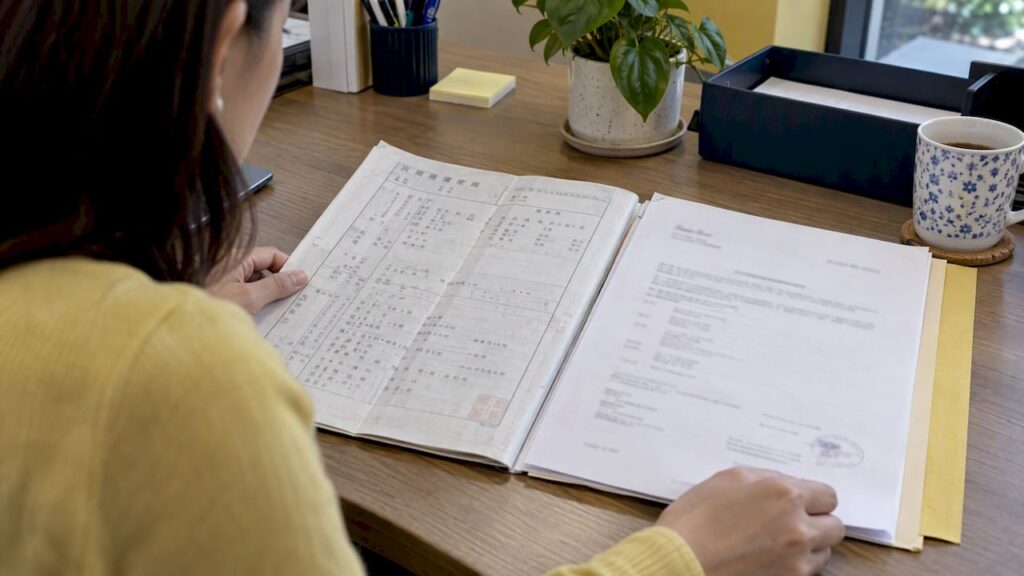
If you need to file a foreign-language document in an Australian court, the translation must come from a translator who holds a valid NAATI credential, and it will often need to be supported by an affidavit. A casual or machine translation is the most common reason a document gets questioned. This guide explains what “certified court translation” actually means, which documents usually need it, how to prepare and submit one, and what to check before you pay.
TL;DR
- Australian courts generally expect a translator with a current NAATI credential, and lawyers are expected to find one through the NAATI directory.
- “Court certified” is not a separate NAATI credential. It describes a translation that meets the court’s standard for use as evidence.
- Many courts want an affidavit from the translator, attaching the original and the English version, sworn or affirmed before an authorised person.
- Send the complete document, a glossary of names and terms, and the deadline up front. Ask for an itemised quote.
- Individuals normally arrange and pay for their own translations. Rules differ by court, so check the court’s own page for your case type.
Table of Contents
- What court document translation means in Australia
- What “court certified” really means
- Which documents usually need translating
- The affidavit step
- Do the rules vary by court and state?
- How to prepare a document for translation
- What to check before you accept the translation
- Timing and cost
- Perspective: why court work rewards specialists
- Get your court document translated
- Common mistakes that get translations questioned
- FAQ
- Sources
What court document translation means in Australia
A court document translation is an English version of a foreign-language document that a party wants the court to read as part of its case. That could be a marriage certificate in a divorce application, a contract in a commercial dispute, a witness statement written in another language, or medical and police records.
The word “certified” causes more confusion than any other. According to the AUSIT best practice guide for official and legal documents, a certified translation in Australia is one done by a translator with a relevant and valid NAATI credential, who certifies it with their name, stamp and a certification statement. AUSIT also points out that the translator is certifying the accuracy of the translation. They are not authenticating the original document. If a document is forged, a certified translation of it is still a translation of a forged document.
Two related words are worth separating. Translating is about written text. Interpreting is about the spoken word, as the NSW Judicial Commission’s bench book on interpreters puts it. If you need someone in the hearing room, that is a different booking from a translated exhibit, and a court will usually organise or approve interpreters through its own process.
What “court certified” really means
You will see providers advertise “court certified translation”. There is no NAATI credential with that name. In practice, the phrase refers to a translation that meets the court’s standards for formal evidence. Court guidance, including the ACT Courts interpreter protocols, points legal practitioners to the NAATI directory to find a suitably credentialed language professional.
So the test you can apply is simple:
- Is the translator’s NAATI credential current and relevant to translation work?
- Does the translation carry the translator’s name, stamp and certification statement?
- If the court wants an affidavit, can the translator provide one and attach the source and translated documents?
If the answer to all three is yes, you have what “court certified” is trying to describe.
Which documents usually need translating
The list depends on your case, but these come up most often:
| Document type | Typical use in court |
|---|---|
| Marriage, birth and death certificates | Family law, divorce, parenting and estate matters |
| Affidavits and witness statements | Any civil, family or criminal proceeding where the witness wrote in another language |
| Contracts, emails and business records | Commercial and employment disputes |
| Police and court records from overseas | Criminal, migration and family matters |
| Medical reports and hospital records | Personal injury, guardianship, family law |
| Financial statements and bank records | Property settlement, debt recovery, fraud |
| Wills and powers of attorney | Probate and guardianship |
The Federal Circuit and Family Court (FCFCOA) gives a clear example. For a foreign marriage certificate in a divorce application, its eFiling guidance refers to a dedicated “Affidavit Translation of Marriage Certificate” form. The translator attaches copies of the source and translated documents and states their qualifications. It is a good illustration of how specific a court can be about the format.
The affidavit step
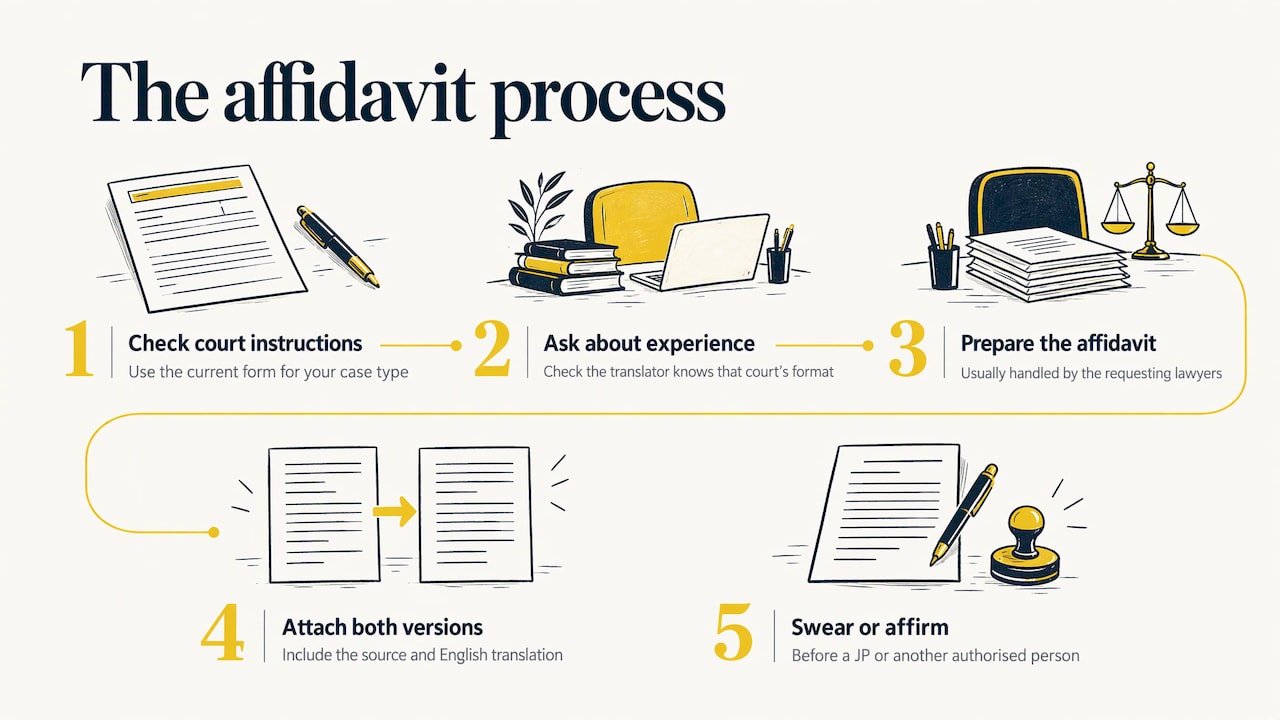
The certification statement on a translation and a court affidavit are not the same thing. The AUSIT guide explains that court translations may require an affidavit instead of, or on top of, the usual certification. The affidavit is usually prepared by the lawyers who requested the translation. It attaches the source document and the English version, and the translator swears or affirms it before a Justice of the Peace or another authorised person.
If you are representing yourself, do not guess. Read the court’s current form and instructions for your case type, and ask the translator whether they have prepared affidavits for that court before. A translator who knows the format saves a round of corrections, and corrections cost both time and money when a filing date is close.
Do the rules vary by court and state?
Yes, in detail, though the core idea is consistent: a credentialed translator, a complete English version, and a formal statement or affidavit confirming accuracy. Differences show up in:
- Forms. Family courts publish particular affidavit forms for translations. Other courts rely on their general rules for affidavits and evidence.
- Practice notes and protocols. Federal, state and territory courts each issue their own guidance on interpreters and translated material, such as the ACT protocols linked above and the NSW bench book.
- Case type. A divorce application, a Local Court debt claim and a Supreme Court commercial matter do not ask for the same paperwork.
- Filing method. Some courts take documents through an online portal with file-size, format and naming rules.
Because these change, the safest habit is to read the registry’s page for your court and case type before you order. If your matter has a solicitor, ask them which form and which attachments they want. If it does not, call the court registry and ask what they need to see with a translated document. The registry cannot give legal advice, but it can usually tell you what format is accepted for filing.
How to prepare a document for translation
Government language services guidance, such as the Australian Government Language Services Guidelines, stresses that translators produce better work when they are given background material, glossaries of specialised terms, and clear instructions about the audience and layout. For a court document, that translates into a short checklist:
- Send the whole document. Every page, stamp, handwritten note, seal and margin comment. Courts want a complete rendering, and translators typically describe non-text elements such as stamps and signatures in square brackets.
- Use a clear scan or photo. Illegible text leads to bracketed “illegible” notes, which an opposing party may query.
- Give the correct spelling of names. Use the spelling on the passport or visa for each person, place and company. A name spelled two ways across your evidence creates avoidable questions.
- Share the context. Tell the translator which court, which case type and which party you are. Include earlier translated documents so terminology stays consistent.
- State the deadline. Give the filing or hearing date, not just “urgent”.
- Ask what comes back. Confirm you will receive the translation with certification, and an affidavit if your court requires one.
What to check before you accept the translation
The same Government guidance and AUSIT’s guide point to a few checks that apply directly to court work.
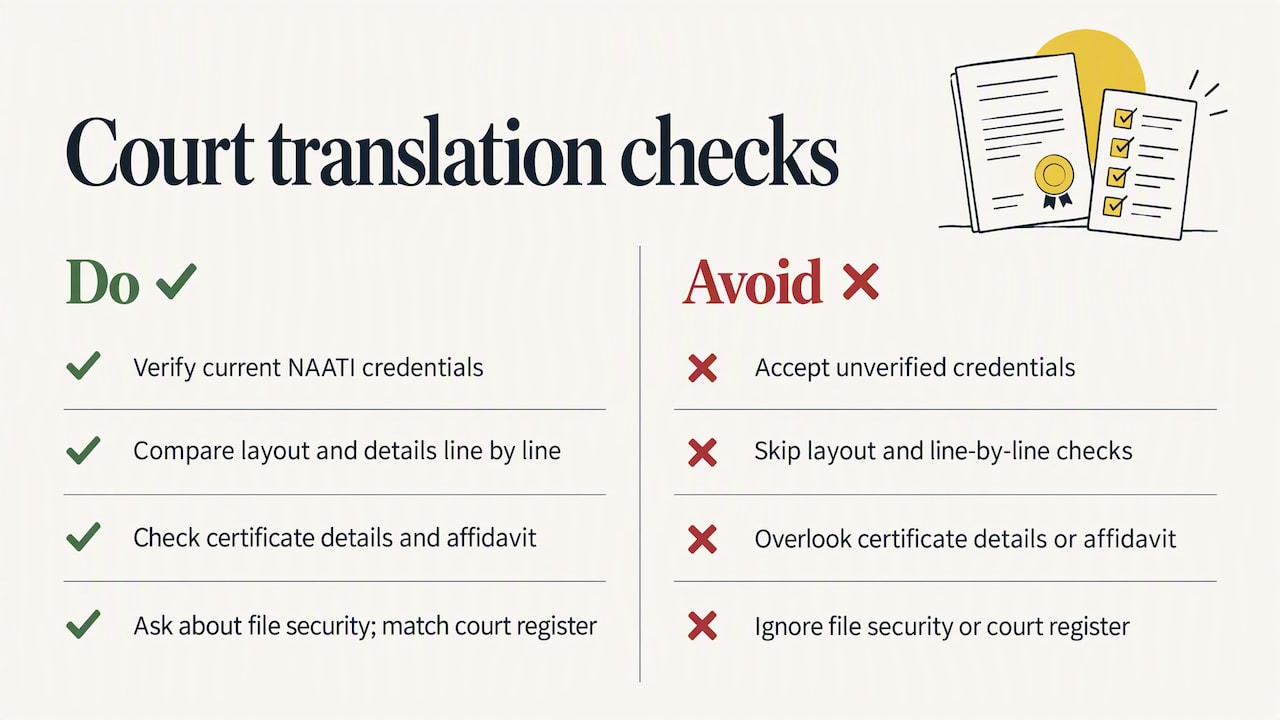
Credentials. Ask for the translator’s NAATI credential details and confirm they are current. A certified translation without a verifiable credential is just a translation.
Completeness. Compare page counts and layout with the original. Check names, dates, amounts and reference numbers line by line. A transposed date on a contract or certificate can change the meaning of evidence.
The right certificate. Check that the certification statement names the translator, the language pair, and the document translated. If an affidavit is needed, check it is attached or on its way.
Confidentiality. Court material is sensitive. Ask how files are stored and shared, whether the translator is bound by a professional code of ethics, and what happens to the documents after the matter finishes. Professional practice commonly includes secure destruction of sensitive documents after a hearing, so ask for it in writing if it matters to you.
Fit for the audience. A judge reads the translation, so the English should be clear and faithful to the original register. A legal contract should read as a legal contract, and a handwritten letter should keep its informality.
Timing and cost
Cost and turnaround depend on length, complexity, language pair and how quickly you need it. Government guidance recommends getting itemised quotes, and it is worth doing before you commit. Compare what is included: certification, an affidavit, rush handling, delivery of the signed original. A low per-word rate that leaves out the certification is not a bargain.
Two budgeting points specific to court:
- Deadlines belong to the court, not the translator. Check the filing date for your evidence and work backwards. Leave time for the affidavit to be sworn or affirmed, since that requires an appointment with an authorised person.
- Who pays. The FCFCOA’s migration interpreter page explains that individuals are responsible for arranging their own document translations. In exceptional circumstances a judicial officer may authorise and fund a translation to assist in a defended hearing. Do not plan around that exception. The Government guidance also notes that costs orders can follow an unsuccessful case, so a tight budget is a reason to translate only what you actually intend to rely on, and to ask your lawyer which documents those are.
Our own published starting rates are from $0.12 per word for certified translation and from $0.08 per word for standard translation, listed on our certified and standard translation page. Court documents are priced on the actual document, so send it for a quote rather than working from the starting rate alone.
Perspective: why court work rewards specialists
Court translation is not ordinary translation with a stamp on the end. A judge, an opposing lawyer or a registry officer will read the English version closely, sometimes against the original, and a small slip in a date, a name or a legal term can cost a party credibility.
That is why we put NAATI-certified translators at the centre of our work. Since 2000 we have translated in over 170 languages, with a particular focus on legal documentation, and we treat accuracy and confidentiality as the job, not an add-on.
Our advice to anyone filing a translated document is to start earlier than feels necessary. Send the complete file, tell us the court and the deadline, and we can plan the certification and any affidavit support around your timetable. Most stress in this area comes from last-minute requests, and most of it is avoidable.
Matthew
Get your court document translated
Stellar Translations provides certified and NAATI-certified translation for legal, personal, medical, business and academic documents, with fast turnaround options and strict confidentiality. If you are preparing a court filing, our legal translation and document translation services cover the documents above, and our team can advise on how the certification is presented for the court you are filing in.
If the matter involves medical reports or hospital records, see our medical translation service. If you also need someone in the hearing room, our interpreting services are the place to start. Send the document, your court and your deadline, and ask for an itemised quote.
Common mistakes that get translations questioned
- Translating only the “important” pages. Courts want the whole document, and omissions invite suspicion.
- Using a bilingual friend or relative. They may be fluent, but they hold no credential and have an interest in the outcome. A court is far more comfortable with an independent, credentialed translator.
- Relying on machine translation. Output from an app may be fine for understanding a letter, but it carries no certification and no accountable author.
- Confusing certified copies with certified translations. Having a document certified as a true copy by an authorised person is a different step from having its translation certified by a translator. AUSIT highlights this very confusion.
- Leaving the affidavit until the end. Swearing or affirming requires an authorised witness, and that takes time to arrange.
- Inconsistent names. Using one transliteration in the translation and another in your affidavit leads to questions.
FAQ
Does a court in Australia require a NAATI-certified translator?
Courts generally expect one. Court guidance directs lawyers to the NAATI directory to find a credentialed translator. Requirements differ by court and case type, so confirm what your registry or solicitor expects before you order.
Is “court certified translation” a special type of certification?
No. It is not a standard NAATI credential. The phrase describes a translation that meets the court’s standard for evidence, which in practice means a NAATI-credentialed translator’s certified work, and an affidavit when the court asks for one.
Do I need an affidavit with my translation?
Often, yes, particularly in family law. The translator or the requesting lawyers prepare an affidavit attaching the source and English documents, sworn or affirmed before a Justice of the Peace or another authorised person. Check the form your court publishes for your document type.
Who pays for the translation of my court documents?
Individuals usually arrange and pay for their own translations. The FCFCOA notes that a judicial officer may authorise and fund a translation in exceptional circumstances for a defended hearing, but that should not be assumed.
How long does a court translation take?
It depends on length, complexity and language. A short certificate can be quick, while a long contract takes longer, plus time for any affidavit. Give the translator your filing date at the start and ask for a turnaround estimate in the quote.