Patent translation is the conversion of a patent specification, its claims and any related text into another language, done so that the legal scope and the technical content stay exactly as the original. In Australia you need it mainly when a PCT application filed in another language enters the national phase and must be supplied in English. The translator you choose decides how safely your claims travel, so this guide covers what is translated, what IP Australia expects, what goes wrong, and what to look for in a German or other NAATI-certified translator.
TL;DR
- A patent translation must reproduce the original claims and disclosure without adding or removing meaning. The translated text can become the application itself.
- Australia requires an English translation of a non-English PCT application for national phase entry, within the applicable time limit.
- IP Australia no longer requires a certificate of verification for every translation, but examiners can still ask for one or for a corrected translation.
- Look for a translator with NAATI Certified Translator credentials in the right language direction, plus technical knowledge of your field.
- We offer certified translation from $0.12 per word and standard translation from $0.08 per word, with NAATI-certified options for official use in Australia.
Table of Contents
- What patent translation actually involves
- When you need a patent translated for Australia
- Do you need a certificate or a NAATI translator?
- What goes wrong when a patent translation is poor
- How a careful patent translation is carried out
- What patent translation costs
- Perspective: why we treat patents as legal documents first
- Working with Stellar Translations
- FAQ
- Sources
What patent translation actually involves
A patent is two documents in one. It is a technical disclosure that explains how an invention works, and it is a legal instrument whose claims define what you own. A patent translator has to serve both at once.
In practice the job covers the title, abstract, description, claims and any text inside drawings, such as labels in flow charts or block diagrams. It can also include priority documents, office actions and correspondence with an examiner. The IP Australia manual describes the translation of a specification as the faithful rendering of that material, and it treats the text as the thing that will be examined.
That is why IP Australia’s examination manual matters to anyone ordering one. It sets out how translations of specifications are handled, what examiners check and what happens when a translation is poor.
Why legal accuracy and technical accuracy are different skills
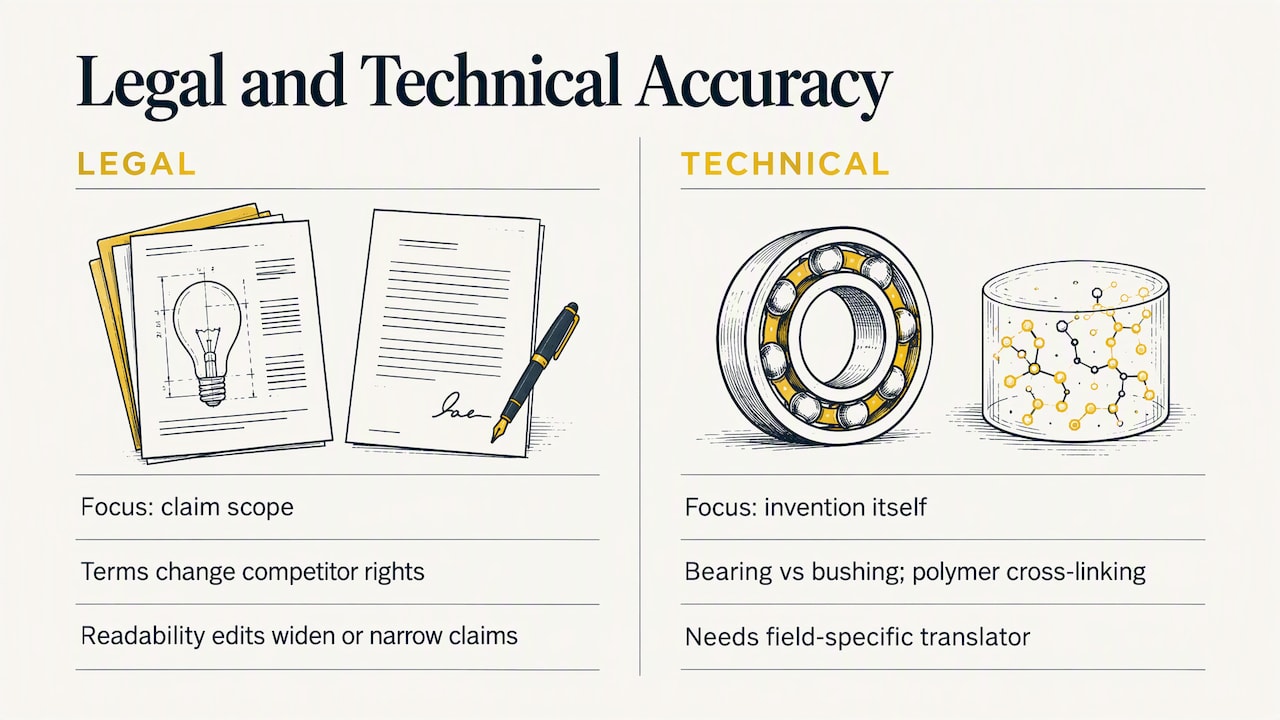
Legal accuracy is about claim scope. A word such as “comprising” versus “consisting of” changes what a competitor can lawfully do. A translator who “improves” a sentence for readability may widen or narrow a claim without noticing.
Technical accuracy is about the invention itself. A translator who does not know the difference between, say, a bearing and a bushing, or between two kinds of polymer cross-linking, will pick a plausible word that an engineer would reject. The two skills rarely sit in one person by accident, which is why patent work is usually matched to a translator by field: mechanical, chemical, electrical, biotech or software.
The Federal Court has set the standard in plain terms. In Fina Research SA v Halliburton Energy Services Inc, the court said a translation should reproduce the original sense and information as exactly and precisely as reasonably practicable, without adding or subtracting meaning. That is the benchmark your translator should work to.
When you need a patent translated for Australia
There are three common situations.
- PCT national phase entry. If your international application was filed in a language other than English, Australia requires an English translation to enter the national phase. The PCT Applicant’s Guide for Australia states the requirement and the applicable time limits, which are set under PCT Article 22. Check the guide for the current limits rather than relying on a figure from an old article.
- Examination and prosecution. If an examiner raises a clarity objection, you may need to correct or retranslate part of the specification.
- Prior art and freedom to operate. Foreign patents that you need to understand, rather than file, often need a reliable translation so that your attorney can assess them. This type of reading translation is a different job from a filing translation, and you should say which you need when you ask for a quote.
Outbound work runs the other way. An Australian applicant who wants protection in Germany, Japan or China will need the specification translated into those languages for each national filing, and the local office will have its own rules on format and timing.
What the translation becomes in law
One point surprises many applicants. In the Fina Research decision, the court noted that the verified English translation becomes the description and claims of the application, whether or not it accurately reflects the original document. In other words, your original-language filing does not protect you if the English version says something narrower.
IP Australia examiners do basic checks, such as looking for missing pages. They do not audit the translation line by line. The accuracy of the translated specification remains the applicant’s responsibility, so the quality control has to happen before you file.
Do you need a certificate or a NAATI translator?
The rules have changed. As of 26 September 2019, a certificate of verification is no longer filed as a matter of course for every translation. Examiners can still ask for a certificate, or for a corrected translation, if they doubt that the text is accurate. So the practical position is this: you may not need certification to file, but you want a translation that would survive being certified.
There are good reasons to use a certified translator anyway:
- A certified translator stands behind the work professionally, which helps if the examiner questions it.
- Related documents, such as assignments, powers of attorney, company records and identity documents, are often needed alongside the patent and may need certified translations for other authorities.
- It gives your patent attorney a clear accountability trail.
What NAATI certification means
NAATI is the national standards body for translators and interpreters in Australia. Its Certified Translator credential is an objective assessment of the skills needed to work as a professional translator, and it is the highest translator credential in NAATI’s certification system.
Two cautions apply to patents. First, NAATI certification proves translation skill in a language direction, not expertise in your technology. Second, the credential is direction-specific, so a translator certified from German into English is not automatically certified for English into German. Ask for the direction you need, and ask separately about subject experience.
Finding a German NAATI translator for patent documents
Germany is a major patent jurisdiction, and German is one of the languages people most often search for here. If you need a German NAATI translator for a patent, check these points:
- Credential and direction. NAATI offers German certification in both directions, so confirm which one applies to your file: German to English for entering Australia, English to German for filing in Germany or Europe.
- Technical field. Ask whether the translator has worked on patents in your area, for example mechanical engineering, where German patent drafting has its own conventions and long compound nouns.
- Terminology handling. A good translator will build a glossary for your project, so that the same German term always becomes the same English term across the claims and description.
- Review. A second linguist or your patent attorney should read the final text against the original.
- Confidentiality. An unpublished invention is valuable. Ask how files are stored, who sees them and whether a confidentiality agreement is signed before you send anything.
These points apply equally to a Japanese, Chinese, French or Korean translator. Only the language and the conventions change.
What goes wrong when a patent translation is poor
Translation errors are quiet. Nobody notices them at filing, and they surface years later, in examination, in a dispute or in court.
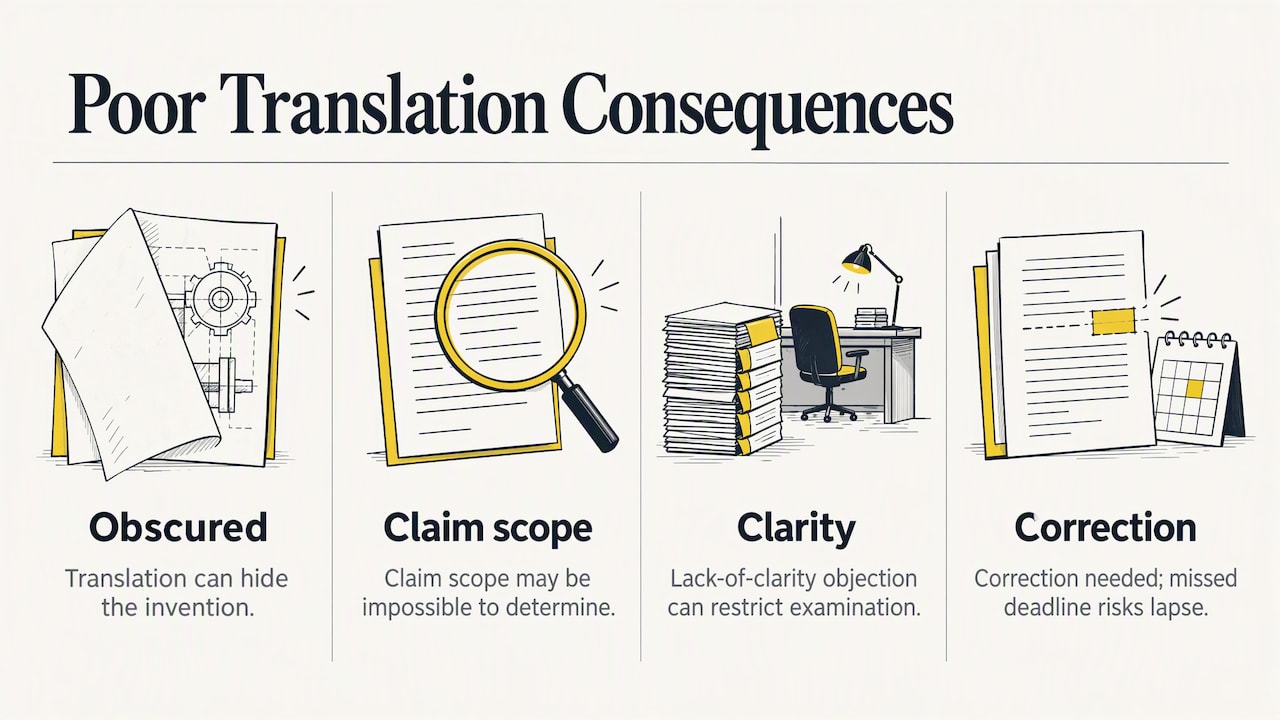
IP Australia’s manual lists the kinds of damage a poor translation can cause. It can obscure the invention, make claim scope impossible to determine, trigger a lack-of-clarity objection, restrict the examination or require a corrected translation. In serious cases, failing to correct a PCT translation within the prescribed period can cause the application to lapse.
There is also a risk at the international level. PCT Article 46 provides that if an incorrect translation gives a granted patent a scope wider than the original-language international application, the competent authority may retroactively limit the scope and declare the patent void to the extent of the excess. The principle is simple: a translation cannot legitimately enlarge what you disclosed.
Common mistakes and how to avoid them
| Mistake | Why it hurts | How to prevent it |
|---|---|---|
| Inconsistent terms for the same part | Claims become ambiguous and can attract a clarity objection | Agree a glossary before translation starts |
| Translating “around” an unclear sentence | Claim scope shifts without anyone choosing it | Have the translator flag unclear source text to your attorney |
| Missing text in drawings | Labels and figure legends are part of the disclosure | Send drawings in an editable or high-resolution format and list them in the brief |
| Machine output used unchecked | Machine tools can mistranslate technical terms and negation | Use machine output for reading only, and have a human translate the filing text |
| Wrong language direction or credential | The translator may not be qualified for the work | Confirm the NAATI direction and subject experience in writing |
| Rushing at the deadline | Review gets skipped | Order the translation well before the time limit, and allow time for attorney review |
Free tools have a role. Patent offices and WIPO publish instant machine translation for patent documents, which is useful for screening foreign patents quickly. A filing is a different matter, because the translated text becomes the legal text.
How a careful patent translation is carried out
The steps below are the sequence we recommend for any technical patent translation, whoever does the work.
- Scope the job. State the purpose (filing, examination response or reading), the language pair and direction, the field and the deadline.
- Send complete source files. Include the specification, claims, abstract, drawings and any earlier translations, so wording stays consistent.
- Build the glossary. Key terms are fixed up front, ideally checked by the inventor or attorney.
- Translate with a subject-matter translator. The translator preserves sentence structure in the claims where the law depends on it, rather than rewriting it into smoother prose.
- Review against the source. A second qualified linguist compares the target text with the original, claim by claim.
- Attorney or inventor read-through. The people who understand the invention check technical sense.
- Certification if needed. Where a certificate or certified copy is required, the certified translator signs off the final text.
- Secure delivery. Files are returned in the format your attorney needs.
If you do not yet have a patent attorney, an explainer on what a patent attorney does shows how that professional fits into filing and why they should see the translation before it goes in.
What patent translation costs
Patent translation is priced per word, because the source length is known before work starts. The main factors are:
- Language pair. Common pairs such as German to English usually cost less than rarer ones.
- Technical difficulty. Chemistry and biotech claims need more specialist time than a simple mechanical device.
- Certification. A certified translation carries a higher rate than a standard one.
- Turnaround. Urgent jobs cost more because they displace other work.
- Review level. A second-linguist check adds cost, and for a filing it is worth it.
- Source quality. A scanned, low-quality PDF takes more handling than an editable file.
At Stellar Translations, our published rates start from $0.12 per word for certified translation and from $0.08 per word for standard translation. Patent work is quoted on the document itself, so send us the file and the purpose and we will confirm the price. Because the price depends on the word count, you can estimate it yourself: a specification of 10,000 words at the “from” certified rate starts at $1,200, before field, language pair and turnaround are taken into account.
Perspective: why we treat patents as legal documents first
Patents are the documents where a single word can be worth more than the translation fee many times over. We have been translating since 2000, and the lesson we repeat to clients is that a patent is a legal text that happens to be technical, not the other way round.
That is why we put our NAATI-certified translators on work that has to stand up with Australian authorities, and why we match language and subject experience before we accept a job. Our strengths are legal and technical documentation, over 170 languages, and a firm approach to confidentiality, which matters most when an invention has not yet been published.
Our advice is to treat the translation as part of the drafting process. Share your attorney’s instructions, agree terminology early, and leave time for review. A translation delivered with room to check it is almost always a better translation.
Matthew
Working with Stellar Translations
If you have a patent specification, a set of claims or supporting documents to translate, our team in Melbourne handles certified and standard translation across more than 170 languages, including NAATI-certified work for official use in Australia. We also translate the paperwork that travels with a patent, such as legal agreements, business records and technical manuals, so one provider can keep terminology consistent across the whole file.
See our certified, standard and NAATI-certified translation options for rates and requirements, or look at our legal translation services if your documents form part of a wider legal matter. Send the file, the language pair and the purpose, and we will come back with a quote.
FAQ
How much does patent translation cost in Australia?
It is usually charged per word and depends on language pair, technical field, certification, turnaround and review level. Our certified translation starts from $0.12 per word and standard translation from $0.08 per word. We quote patent work from the actual document so the price reflects its length and difficulty.
Do I need a certified translation to file a patent in Australia?
Not always. Since 26 September 2019 IP Australia no longer requires a certificate of verification for every translation, but examiners can still request one, or a corrected translation, if they doubt accuracy. Using a certified translator from the start reduces that risk.
Is machine translation good enough for a patent?
It is useful for reading and screening foreign patents quickly. It is not a safe basis for a filing, because the translated text becomes the legal text of the application and the applicant is responsible for its accuracy. Have a qualified human translator produce and review the filing text.
What should I check when hiring a NAATI German translator?
Confirm the NAATI Certified Translator credential and the direction you need, since German certification is offered in both directions. Then ask about experience in your technical field, how they manage terminology, and how they protect confidential files.
How early should I order the translation for PCT national phase entry?
As early as you can. The English translation must be supplied within the time limit set under the PCT, and a translation that needs correcting can cost you further time. Check the limit in the PCT Applicant’s Guide for Australia and plan for review before the deadline.