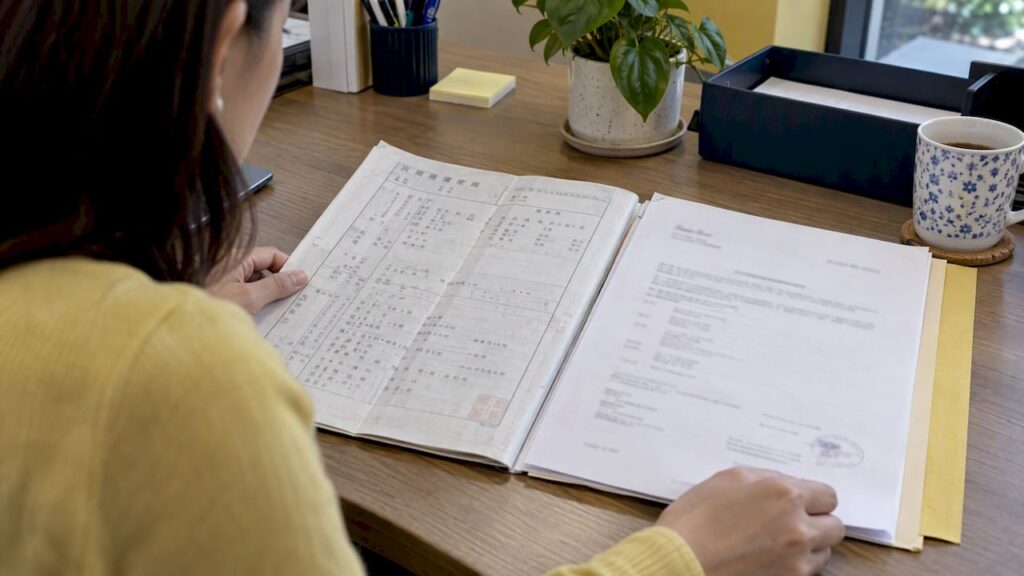
An affidavit translation is an English translation of a foreign-language document, paired with a sworn or affirmed statement from the translator that the translation is true and correct. Australian courts ask for it when you file a document that is not in English. The translator’s affidavit sets out their qualifications, attaches the original and the translation, and is sworn or affirmed before an authorised witness such as a Justice of the Peace or a lawyer.
This guide explains when a court wants one, what goes in it, who signs what, and how it differs from the NAATI-certified translation you may use for immigration or other official purposes.
TL;DR
- If a document you must file with an Australian court is not in English, the court rules require an English translation plus an affidavit from the translator verifying it and setting out their qualifications.
- A standard certified translation (translator’s name, stamp and certification statement) is not the same thing as an affidavit, which must be sworn or affirmed before an authorised person.
- For divorce applications, a foreign marriage certificate needs the court’s own form, Affidavit: Translation of Marriage Certificate, sworn or affirmed before a Justice of the Peace or a lawyer.
- The affidavit is usually prepared by the lawyer requesting the translation. Start with a qualified translator and ask the court registry or your lawyer exactly what it expects.
- Translators cannot certify photocopies of your original as true copies. A Justice of the Peace, police officer, pharmacist or lawyer does that.
Table of Contents
- What an affidavit of translation is
- When Australian courts require one
- What the affidavit must contain
- Who does what
- How to prepare and file an affidavit translation
- Our perspective
- Getting your translation done
- FAQ
- Sources
What an affidavit of translation is
An affidavit is written evidence given to a court and confirmed by oath or affirmation. An affidavit of translation applies that idea to a translated document. The translator states, under oath or affirmation, that the attached English version is an accurate translation of the original.
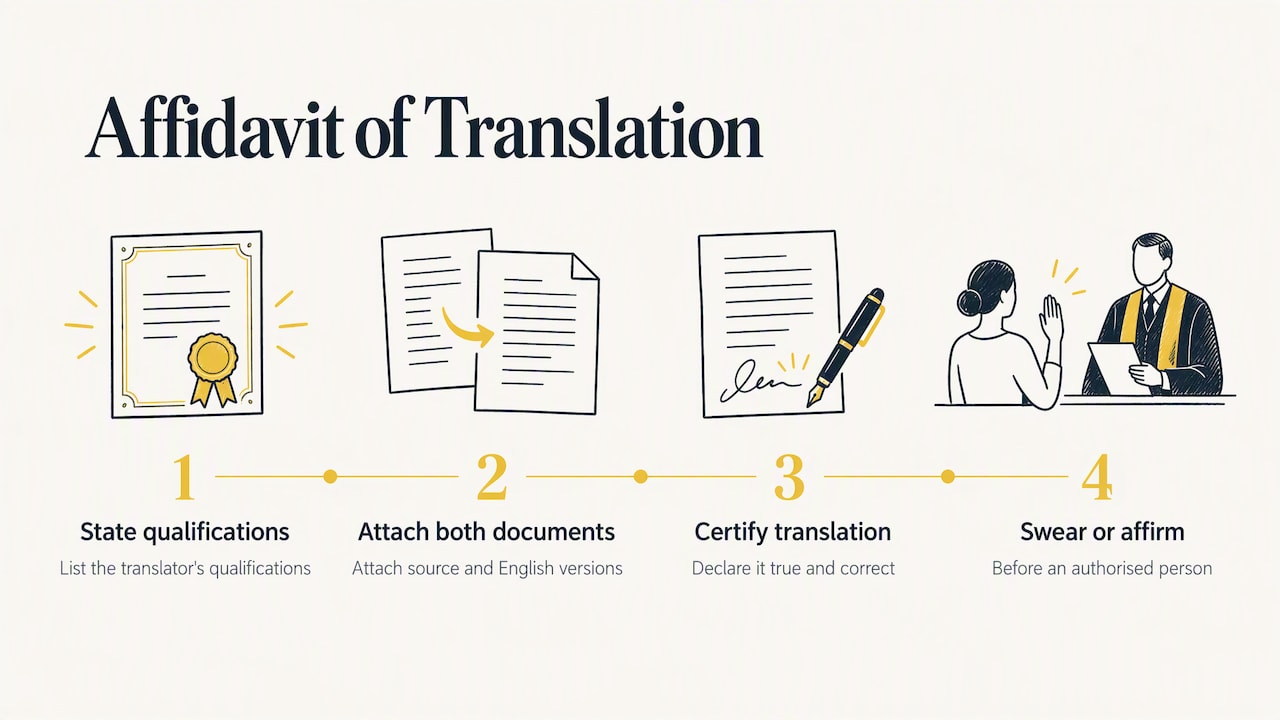
According to the AUSIT best practice guide for official and legal documents, an affidavit for a court may be required instead of a simple certification. It sets out the translator’s qualifications, attaches copies of the source and target documents, and certifies that the attached translation is true and correct. It must then be sworn or affirmed before an authorised person.
The typical wording you will see in templates follows the same logic: the translation is “annexed” or attached and marked with a letter, commonly “B”, and the translator declares it an accurate English translation of the named document. The exact wording depends on the court and the form, so use the court’s own version when one exists.
How it differs from a certified translation
In Australia, a certified translation is done by a translator holding a valid NAATI credential, who adds their name, stamp and a certification statement to the translation. The AUSIT guide describes this as the standard approach. It is what most government agencies, universities and migration processes expect.
An affidavit goes a step further. The translator is not just certifying, but making a sworn statement in a formal legal setting, with consequences if it is false. That is why courts prefer it.
| Certified translation | Affidavit of translation | |
|---|---|---|
| Who prepares it | A translator with a valid NAATI credential | Usually the lawyer requesting the translation, completed by the translator |
| What is added | Translator’s name, stamp and certification statement | Sworn statement of qualifications, attached source and translation, declaration that it is true and correct |
| Witness needed | No | Yes: a Justice of the Peace, lawyer or other person authorised to take an oath or affirmation |
| Typical use | Immigration, education, government and business paperwork | Court filings |
In practice the two work together. You normally need a competent, credentialed translator first, and the affidavit sits on top of that work.
When Australian courts require one
The rule is consistent across the courts that deal with most family and civil matters, though each has its own wording.
Family law: Rule 2.17
Under Rule 2.17 of the Federal Circuit and Family Court of Australia (Family Law) Rules 2021, if a document that must be filed with the court is not in English, the filer must also file an English translation and an affidavit by the translator verifying it and setting out their qualifications.
This covers more than certificates. Foreign court orders, police reports, medical records, bank statements, messages and statutory declarations from overseas can all turn up in a parenting or property case. Each needs the same treatment.
Divorce applications and foreign marriage certificates
This is the most common reason people search for this topic. The Family Law Practice Direction on divorce proceedings says that if a marriage certificate is not in English, the applicant must file an English translation annexed to an Affidavit: Translation of Marriage Certificate. The translator completes the form and verifies their qualifications.
The court publishes the form itself. Per the court’s form page, the affidavit must be sworn or affirmed before a Justice of the Peace or a lawyer. If you are preparing a divorce application with a foreign certificate, use that form rather than a generic template.
Federal Court: certified translation
The Federal Court is slightly different. Under Rule 28.50 of the Federal Court Rules 2011, a party who wants to rely on a document that is not in English must provide a certified English translation to the Court and to any other party to the proceeding. That is a certified translation requirement, so check whether the judge, the registry or the case directions also want a sworn statement from the translator.
State and territory courts
Local and state courts, tribunals and registries set their own practices. We do not rely on a single rule for all of them. If you are filing in a Victorian, New South Wales or Queensland court, or a tribunal, ask the registry or your lawyer what it accepts before you order the translation. That one call can save you a second round of paperwork.
What the affidavit must contain
Courts publish their own forms for some documents, but the substance is always the same. Going by the AUSIT guide and the court materials above, a sound affidavit of translation includes:
- The translator’s details and qualifications. Name, address and the credential that makes them competent, such as NAATI certification for the language pair.
- The identity of the source document. What it is, its language, its date and issuing country, so there is no doubt which document was translated.
- A copy of the original (the source document) attached. Marked with a letter, commonly “A”.
- The English translation attached. Marked with the next letter, commonly “B”.
- A statement that the translation is true and correct. The translator confirms it is an accurate translation into English prepared by them.
- The jurat. The oath or affirmation section, signed by the translator in front of the authorised witness, who signs and dates it.
The oath taker may also stamp and sign the attachments, depending on what the court requires. If your court’s instructions mention initialling or marking each page, ask for that to be done at the signing.
Oath or affirmation?
Either is acceptable in law. An oath is usually sworn on a religious text; an affirmation is a secular promise of the same weight. The witness will ask which you prefer, so decide beforehand.
Who does what
People mix up the roles, and that causes most of the delays.
The translator produces the translation, states their qualifications and swears or affirms that the translation is accurate. The translator must be competent in both languages. For marriage consent documents, for example, the Marriage Regulations 2017 require that a translation of consent to the marriage of a minor be done by a person accredited or recognised by NAATI and competent to perform the translation.
The lawyer (when you have one) usually drafts the affidavit. The AUSIT guide notes that court affidavits are usually prepared by the lawyers requesting the translation. If you are self-represented, use the court’s form where it publishes one.
The witness is a Justice of the Peace, a lawyer or another person authorised to take an oath or affirmation. They watch the translator sign and add their own signature, and sometimes a stamp.
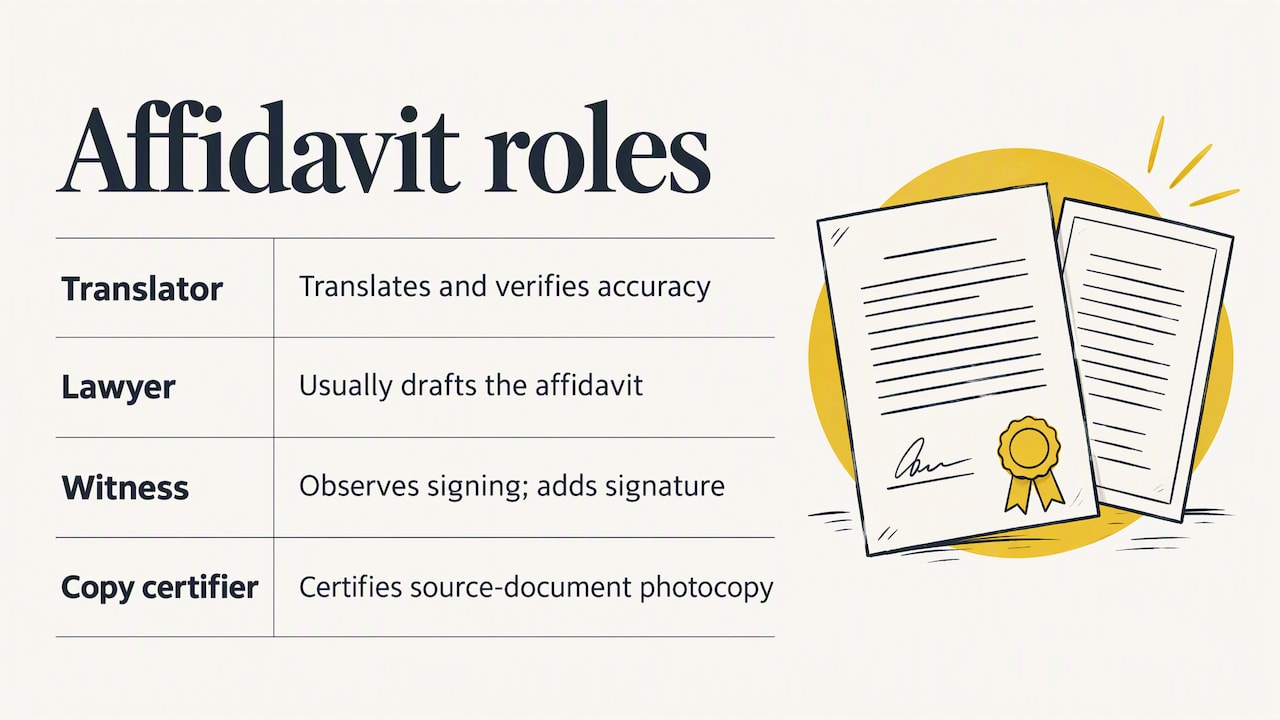
Someone else certifies the photocopy of the original. Translators are not authorised to certify photocopies of source documents as true copies. Under federal legislation that job generally falls to a Justice of the Peace, police officer, pharmacist or lawyer, according to the AUSIT guide. If your court wants a certified copy of the original, arrange that separately.
How to prepare and file an affidavit translation
- Check what the court wants. Read the rule or practice direction for your court and, if unclear, ask the registry or your lawyer. Ask three things: does it need an affidavit or only a certified translation, is there a mandatory form, and does the original need to be certified.
- Gather clear copies of the original. Scans should show stamps, seals, handwriting, margins and any back-page text. Translators translate those too.
- Choose a credentialed translator. For court purposes use a translator holding a valid NAATI credential for the language pair. NAATI keeps a directory of certified practitioners, which the Federal Circuit and Family Court points divorce applicants to.
- Have the translation completed. Names, dates and place names must match your other documents. Agree in advance on spellings that appear in passports or visas.
- Complete the affidavit. Use the court’s form or your lawyer’s draft. Attach the source copy and the translation, marked with letters.
- Swear or affirm before an authorised witness. Take photo ID. Do not sign in advance: the witness must see you sign.
- File it. Lodge the affidavit with its annexures through the court’s filing channel. Keep a full copy.
Common mistakes
- Signing the affidavit before meeting the witness. The signature must be given in front of them.
- Attaching only the translation. Courts expect the source document and the translation together.
- Leaving out the translator’s qualifications. Rule 2.17 specifically asks for them.
- Using a generic template when the court has its own form. For divorce, use the court’s marriage certificate form.
- Translating only part of a document. Seals, stamps and marginal notes carry meaning. A partial translation invites questions from the registry.
- Assuming one translation fits every purpose. A translation prepared for a visa application may not be sworn. Ask for the affidavit at the time of ordering.
Our perspective
Most of the enquiries we see about affidavit translation begin with the same worry: “Is my certified translation enough?” The honest answer is that it depends on who will read it. A NAATI-certified translation satisfies most official bodies in Australia. A court may want more, and the court decides.
Our view is that the quality of the underlying translation matters more than anything stapled to it. An affidavit only confirms that a translation is accurate. If the translation has the wrong spelling of a name, a date in the wrong format or a missing stamp, the sworn statement does not fix it. That is why we focus on accurate, carefully checked work from experienced translators, with legal documents handled by people who understand how they will be used.
Our practical advice is to tell us at the start that the document is for a court. Give us the court, the type of matter and any instructions from your lawyer or the registry. That lets us match the right translator and format to the requirement, rather than finding out after delivery that something was missing. We have worked in Australia since 2000, across more than 170 languages, and confidentiality is part of how we handle every file, which matters when the documents are personal or part of a legal dispute.
— Matthew
Getting your translation done
If you need a court-ready translation, start with the translation itself. We offer NAATI-certified translation for official use in Australia, with certified translation from $0.12 per word and standard translation from $0.08 per word. Standard translation suits documents that only need to be understood, such as background material your lawyer is reviewing. Certified translation is for documents that will be submitted to an authority.
For legal documents, our legal translation service covers court-related paperwork. Send us the document and tell us the court and purpose, and we will confirm what we can supply before you commit. Pricing for legal translation is not published, so ask for a quote based on your document.
FAQ
What is a translation affidavit?
It is a sworn or affirmed statement by a translator that an attached English translation is a true and correct version of an attached original document. It sets out the translator’s qualifications and is witnessed by an authorised person such as a Justice of the Peace or a lawyer. Courts use it as evidence that the translation can be relied on.
Is a NAATI-certified translation enough for an Australian court?
Sometimes, but not always. A NAATI-certified translation carries the translator’s name, stamp and certification statement, and the Federal Court Rules ask for a certified translation. Family law courts, however, ask for an affidavit from the translator as well. Check the specific rule or ask the registry.
Who can witness an affidavit of translation?
A Justice of the Peace, a lawyer or another person authorised to take an oath or affirmation. For the divorce form on a foreign marriage certificate, the court names a Justice of the Peace or a lawyer. The translator must sign in front of the witness.
Can the translator certify my original document as a true copy?
No. Translators are not authorised to certify photocopies of source documents. That task generally falls to a Justice of the Peace, police officer, pharmacist or lawyer under federal legislation. Arrange the certified copy separately and give it to the translator to attach.
How do I find a qualified translator?
Look for a translator with a valid NAATI credential for your language pair. NAATI maintains a directory of certified practitioners, and translation companies employing credentialed translators can also supply the work. Tell them the document is for a court so the right format is used.
Sources
- AUSIT best practices: translation of official and legal documents
- Federal Circuit and Family Court of Australia (Family Law) Rules 2021, Rule 2.17
- Family Law Practice Direction: Divorce proceedings
- Affidavit translation of marriage certificate form
- Federal Court Rules 2011, Rule 28.50
- Marriage Regulations 2017
- How to eFile further documents for divorce