If you’re lodging a visa application with Home Affairs, every document that isn’t in English needs an English translation, and if the translation is done in Australia it should come from a NAATI-certified translator. Send both the original and the translation, with the translator’s details on it. Get that right and you avoid one of the most common (and most avoidable) causes of delays. We’re Stellar Translations, a Melbourne-based service with NAATI-certified translators, and this guide walks through what officers look for and how to get it right the first time.
A quick explanation of terms. Home Affairs is the federal department that processes visas and citizenship. NAATI (the National Accreditation Authority for Translators and Interpreters) is the national body that certifies translators and interpreters in Australia. It doesn’t translate anything itself. It certifies the people who do.
TL;DR
- Any document not in English needs an English translation, and you supply the original document as well as the translation.
- If the translator works in Australia, use a NAATI-certified translator and make sure their NAATI details appear on the translation.
- Every translation should show the translator’s full name, address, phone number and qualifications, all in English.
- Scan documents clearly, keep multi-page documents in one PDF, and keep each file within the upload limit shown in your ImmiAccount.
- Machine translations and translations by friends or family are a common reason for requests for more information, so book a certified translator before you lodge.
Table of Contents
- What Home Affairs actually asks for
- Does the translator have to be NAATI-certified?
- What a compliant translation looks like
- Full translation or extract translation?
- Which documents usually need translating?
- How to get your documents translated, step by step
- Why translations get rejected, and how to fix it
- What changed recently for NAATI translators
- Making it easy: what we do
- Quick checklist before you lodge
- FAQ
What Home Affairs actually asks for
The rule is simple. Home Affairs’ guidance for attaching documents to an application says that anything not in English must come with an English translation, and that you need to provide the original as well as the translation. The department’s “Check twice, submit once” guidance adds that if the translator is in Australia, the translation must include their NAATI practitioner number.
Three things follow from that:
- Original plus translation. The translation never replaces the original. Officers compare the two.
- A named, qualified translator. The translation must show who did it and why they’re qualified.
- English throughout. The translator’s details need to be in English too, so a case officer can read them.
Requirements can differ slightly depending on your visa subclass and where you lodge, so check the document checklist for your own application in your ImmiAccount on the Home Affairs website before you order anything.
Does the translator have to be NAATI-certified?
If the translation is done in Australia, yes. Home Affairs expects a NAATI-certified translator, and NAATI itself says most Australian government agencies require this where certification is available for the language in question.
If the translation is done overseas, NAATI certification isn’t required. The translation still has to carry the translator’s full name, address, phone number and their qualifications and experience in that language. Some Australian embassies also ask for a sworn translator in certain countries for official documents like birth and marriage certificates, so check the embassy page for the country you’re lodging from.
One thing catches people out: a translator can’t certify someone else’s work. If a relative, a friend or a free online tool produced a translation, a NAATI translator can’t simply stamp it. The whole document usually has to be translated again. If you’re in Australia, it’s cheaper and faster to start with a certified translator than to redo it after a request for more information.
We cover this in more detail in our practical guide to NAATI document translation.
What a compliant translation looks like
A certified translation in Australia is more than the text converted into English. Professional guidance from AUSIT, the translators’ professional association, describes it as a translation done by a translator holding a valid NAATI credential and certified with their name, stamp and a certification statement.
Here’s what an officer expects to see:
| Element | What it should show |
|---|---|
| Translator details | Full name, address, phone number, in English |
| Qualifications | Credential and experience in the language pair |
| NAATI details | Practitioner number, language, type of certification |
| NAATI stamp | Physical or digital, either is accepted, with date and signature |
| Certification statement | A short statement that the translation is true and accurate |
| Source document | An image of the original attached to the translation |
Some points worth knowing:
- The NAATI stamp can be a physical stamp or a digital one. Both are valid, and only one type is needed.
- When a translation is going to be legalised (for example for use overseas through DFAT), the NAATI stamp on every page needs to be legible, including the QR code.
- The translator typically attaches an image of the source document to the back of the translation, so it’s clear exactly which document was translated.
If something is missing or illegible, such as a stamp that’s been cropped off in a scan, the case officer may treat the translation as incomplete.
Full translation or extract translation?
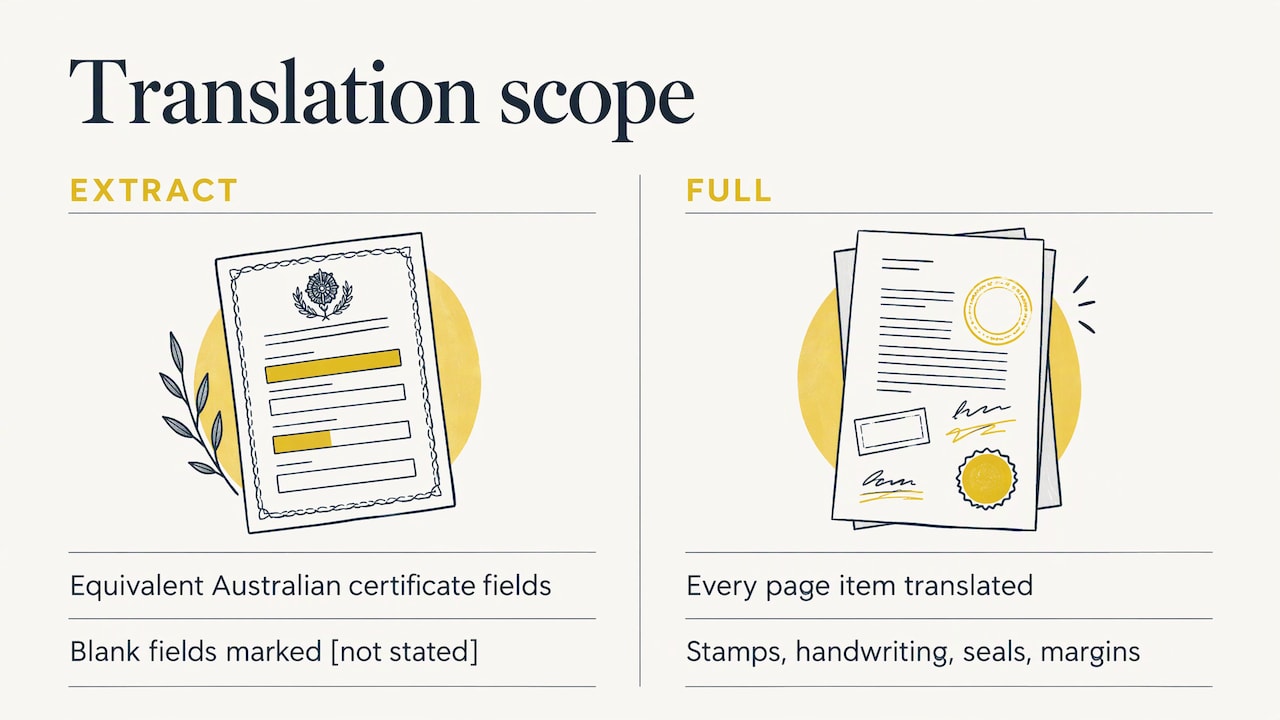
For standard personal documents like birth certificates, Australian officials often accept (and AUSIT notes they often prefer) an extract translation. That’s a set format that includes only the information that would appear on an equivalent Australian certificate. Fields that are blank or missing in the original are marked with a translator’s note such as “[not stated]”.
Most other documents, such as court orders, academic records with detailed content, employment references and contracts, need to be translated in full. Everything on the page gets translated: stamps, handwritten notes, seals and margin text.
A document that’s mostly in English but has some text in another language or script still needs translating. A bilingual certificate isn’t automatically fine.
If you’re not sure which format suits your document, tell us the visa type and the document when you ask for a quote. Our guide to official document translation explains what authorities typically accept.
Which documents usually need translating?
It depends on your visa, but these are the ones people most often submit in another language:
- Birth certificates and family registers
- Marriage and divorce certificates
- Passports and national ID cards (only the pages that aren’t already clear to an English reader)
- Police clearance certificates
- Academic transcripts, degrees and graduation certificates
- Employment references, contracts and payslips
- Military service or discharge records
- Custody and adoption documents
- Bank statements and tax records, where the content isn’t clear in English
Some embassies note that passports, bank statements and tax declarations don’t need translation when an English-only reader can understand the information. If a document is borderline, translate it. A short translation costs far less than a delay.
A note on “sight translation”, which some people search for. That’s when an interpreter reads a document aloud in another language. It’s useful in a meeting or an appointment, but it doesn’t produce a written document you can attach to an application. For lodging a visa, you need a written translation.
How to get your documents translated, step by step
1. Check your document list first
Open the checklist for your visa in your ImmiAccount and note every document that isn’t in English. This is also the time to confirm names and dates of birth match across your documents. Inconsistent spellings between a passport and a certificate cause trouble, and the translator needs to know which spelling to follow. If a name is spelled differently on two documents, tell your translator before they start.
2. Scan the original properly
A scan is better than a photo. If you have to use a phone, take it directly above the page, in colour, with no shadows and no glare from plastic sleeves. Make sure all four corners, every stamp and any handwriting on the back are visible. Home Affairs wants high-quality scans, so a blurry file can cause the same problems as a missing document.
3. Choose a NAATI-certified translator
If you’re in Australia, that’s the safe choice for any official purpose. NAATI keeps an online directory of certified practitioners, so you can confirm a credential is current. Our NAATI-certified service is built for documents used officially in Australia, and we translate in over 170 languages. We’ve been operating since 2000, and confidentiality is part of how we handle every document. Certified translation starts from $0.12 per word, and you can see our service and pricing details here.
4. Send the file and tell us the purpose
Tell the translator which visa or application the document is for. That lets them match the format to what the case officer expects, whether that’s an extract translation or a full one. Mention the country you’re applying from and any special instructions from the embassy page.
5. Check the finished translation before you lodge
Before you upload, run through this list:
- Names, dates, document numbers and places match the original exactly, letter by letter.
- Every page has the certification details and the stamp is readable.
- The translator’s name, address, phone number and qualifications are all there, in English.
- The translation has an image of the source document attached.
- Page counts match: if the original has four pages, the translation covers four pages.
If you spot an error, ask the translator to correct it before you submit. Correcting a typo now is quick. Correcting it after a request for more information, with a deadline running, is stressful.
6. Upload the original and the translation together
In your ImmiAccount, upload files in an accepted format, keep multi-page documents as a single PDF, and avoid compressed or encrypted files. Check the file size limit shown on the upload page, since it applies to each file. Name files clearly, such as “Birth certificate original” and “Birth certificate English translation”, so the officer can pair them quickly.
Why translations get rejected, and how to fix it
When a translation isn’t accepted, a case officer usually sends a request for further information, with a deadline for responding. Migration agents and advisers commonly list uncertified translations, translations by someone who isn’t accredited, and unreadable scans among the causes. If you miss the deadline, the department can decide on the information it already has, which can mean a refusal.
The usual culprits:
- Machine translation. Embassy guidance is clear that free online tools don’t produce an acceptable translation.
- A translation by a friend or relative. Even a good one lacks the certification an officer looks for.
- No NAATI details. In Australia, the practitioner number needs to appear.
- Missing original. The translation was uploaded, but the source document wasn’t.
- Partial translation. A stamp, a margin note or the back of a page was skipped.
- Low-quality scans. The translator’s stamp is cut off or text is unreadable.
- Name or date inconsistencies. Different spellings across pages or documents.
To fix it: read the request carefully, identify exactly which document the officer is questioning, and order a replacement from a certified translator straight away. Upload the corrected translation and the original before the deadline. If your case is complex or you’re close to the deadline, speak to a registered migration agent or a lawyer about your application. We handle the translation side, and for the visa strategy itself, a registered agent is the right person.
What changed recently for NAATI translators
NAATI has been running a reform program. It includes recertification, where practitioners must show ongoing work practice and professional development to keep their credential after the first three years, and a standard certification test for most candidates. For you, this means checking that your translator’s credential is current. The NAATI directory only lists practitioners with valid credentials, so a quick search settles it.
Making it easy: what we do
Our team translates personal, legal, academic, medical and business documents, and immigration paperwork is a regular part of that. Our NAATI-certified translation service is designed for documents needing official acceptance in Australia, and we offer fast turnaround when your lodgement date is close. Certified translation is priced from $0.12 per word, with the final quote depending on your document and language.
If your documents are ready, send them through to us from the Stellar Translations website and tell us the visa you’re lodging for. If you’re based in Melbourne or elsewhere in Australia, our NAATI translation guide for Melbourne covers how local requests work.
Quick checklist before you lodge
- Do I have the original and the English translation for every document not in English?
- Is the translator NAATI-certified (if in Australia), with their number on the translation?
- Are the translator’s name, address, phone number and qualifications included in English?
- Are my scans clear, complete and in one PDF per document?
- Do names and dates match across all my documents?
- Have I checked my embassy’s page if I’m applying from overseas?
FAQ
Do I need to translate documents that are already partly in English?
Yes, if any information on the document remains in another language or script, it needs translating. Stamps, handwritten notes and seals count. A translator can tell you quickly whether the English content is enough on its own.
Can I translate my own documents for a visa application?
It’s not a safe option. In Australia, Home Affairs expects a NAATI-certified translator, and a translation you’ve done yourself or had done by a relative or an online tool is a common reason for a request for more information. Order a certified translation instead.
Do I need a NAATI translator if I’m applying from overseas?
Not necessarily. If the translator is outside Australia, NAATI certification isn’t required, but the translation must still show the translator’s full name, address, phone number and qualifications in English. Some embassies ask for a sworn translator for official documents, so check the embassy page for your country.
How long does a certified translation take?
It depends on the language, the length and the document type. A one-page certificate is usually much quicker than a multi-page transcript. We offer fast turnaround, so tell us your lodgement timeline when you send the document.
What if my translation is rejected after I lodge?
Check the request for further information, find the exact issue, and get a corrected translation from a certified translator before the deadline. Upload it with the original. If your case is complicated, talk to a registered migration agent about the application.