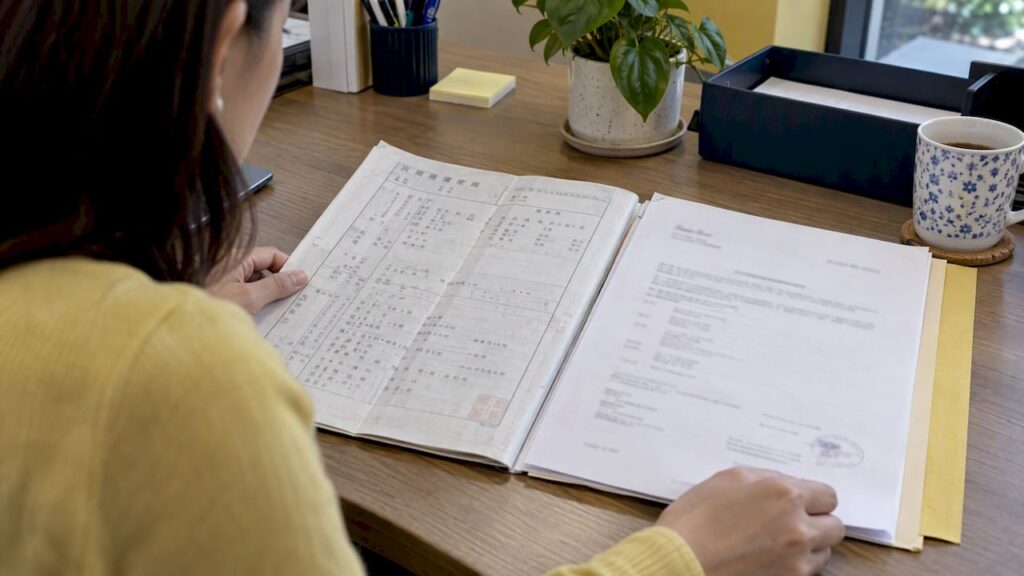
If an Australian authority has asked for your bank statements, financial statements or tax records in English, you need a certified translation: one done by a NAATI-certified translator, who signs it off with their name, stamp and certification statement. A plain translation, or one you ran through an app, usually won’t be accepted. Stellar Translations has provided NAATI-certified translation in over 170 languages since 2000, so a financial document can go to a translator who works in your language pair.
This guide covers who asks for certified financial translations, what the translation must contain, where people trip up, and how to get a document through the first time.
TL;DR
- A certified translation in Australia is done by a translator holding a valid NAATI credential, who certifies it with their name, stamp and a certification statement.
- Bank statements, financial statements, tax returns and payslips are the documents most often requested for visas, tax matters, regulators and study applications.
- Not every authority wants every document translated, so check the exact requirement of the body you’re lodging with before you order.
- Translate the whole document, including stamps, headers, footnotes and handwritten notes, and keep the layout close to the original.
- Certified translation starts from $0.12 per word, and standard translation from $0.08 per word, as published on our FAQ page.
Table of Contents
- What “certified” means for a financial translation
- Which financial documents usually need translating
- Who asks for certified financial translations, and what they expect
- What a properly certified translation contains
- Step by step: getting a financial document translated for official use
- Why accuracy and confidentiality matter more here
- Common mistakes that get documents knocked back
- How we can help
- Who this is useful for
- FAQ
What “certified” means for a financial translation
The word gets used loosely. In Australia, it has a specific meaning. The AUSIT Practitioner Style Guide (AUSIT is the professional association for interpreters and translators) describes a certified translation as one performed by a translator with a relevant, valid NAATI credential, then officially certified by that translator with their name, stamp and certification statement. NAATI is the national body that credentials translators and interpreters in Australia.
That sign-off is what a receiving body is looking for. It tells the officer reading your file that a qualified person stands behind the translation, and that the English matches the original.
Two things are worth knowing early:
- Certified is not the same as notarised. A translator’s certification covers the accuracy of the translation. A notary public confirms signatures or copies. Some processes need both, and your receiving body will say which.
- Certified is not the same as legalised. Legalisation is a separate step done by the Department of Foreign Affairs and Trade (DFAT) so a document can be used overseas. It comes after the translation, and DFAT has its own presentation rules (covered below).
NAATI currently lists Certified Translator as its only certification for translators, with a separate Recognised Practising credential for languages where testing isn’t available. For most major languages, you’re looking for a Certified Translator. If you want a longer look at the credential, our NAATI document translation guide goes through it.
Which financial documents usually need translating
The list depends on why you’re lodging the documents, but these come up most often:
- Bank statements and account letters
- Annual financial statements, balance sheets and profit and loss reports
- Tax returns, tax assessments and income tax declarations
- Payslips and employment income letters
- Loan agreements and mortgage documents
- Company registration and shareholder documents
- Audit reports and accountants’ letters
- Investment and superannuation or pension statements
Bank statements
Bank statements are the most common request. Migration applications, business and investor visas, property purchases and student visa financial-capacity checks all lean on them. Statements are dense: dates, transaction descriptions, abbreviations, reference numbers and currency amounts, often across dozens of pages. Every one of those has to come through correctly.
The NSW Government’s guide to supporting documents for its business and investor visas says non-English documents need an English translation certified by a translator, and within Australia that translator must be NAATI-accredited. If you’re applying through a state program, read that program’s own document list closely.
Financial statements
Company accounts are more technical. A translator has to know the difference between terms that look alike but mean different things under different accounting standards: provisions and reserves, for example, or how an overseas jurisdiction labels equity and liabilities. This is where a translator with financial or technical experience matters more than one who simply knows both languages. Stellar has legal and technical expertise on the team, and our certified technical translation guide explains how that kind of work is handled.
Tax and income records
The Australian Taxation Office (ATO) says records for overseas expenses can stay in the original language. But if the ATO asks you to substantiate a claim, non-English records should come with a translation certified by an authorised service, which includes a NAATI-accredited professional service. In other words, you don’t translate everything up front, but you need to be ready if asked.
Who asks for certified financial translations, and what they expect
Requirements vary a lot between bodies. A few examples from official guidance:
| Body | What it says | What it means for you |
|---|---|---|
| ASIC (corporate regulator) | A non-English document lodged with ASIC must have a certified English translation. Australian-made translations must be certified by a NAATI Professional certified translator. | Company lodgements need a certified translation, not a rough one. |
| ATO | Records may stay in the original language, but non-English records supporting a claim should be accompanied by a certified translation if requested. | Keep originals, and have a translator lined up if you get a request. |
| AUSTRAC (financial crime regulator) | English translations should meet a standard consistent with NAATI Professional Translator accreditation or a comparable overseas standard. | Regulated entities need a high-level translator for specialised content. |
| NSW business and investor visas | Non-English documents need a certified English translation, and in Australia the translator must be NAATI-accredited. | Use a NAATI-certified translator for every supporting document. |
ASIC also notes that overseas-made translations can be certified by certain other people, such as a notary public. If you’re based in Australia, a NAATI-certified translator is the straightforward route.
Requirements aren’t universal. The Australian Embassy in Brazil, for instance, has said in its application guidance that bank statements and annual income tax declarations don’t need translating when the information is clear. That is specific to that application, not an Australian rule. So the safe habit is to read the checklist for your exact application, and if it says “translated”, assume it needs certification.
If your documents are going to a court, our court document translation guide covers what courts accept, and our official document translation page covers government bodies more broadly.
What a properly certified translation contains
The AUSIT guide gives a clear picture of what a finished certified translation should look like:
- A complete translation. All text is translated, including stamps, seals, letterheads, footnotes and handwritten notes. Where something is illegible, the translator flags it rather than guessing.
- A layout close to the source. The translation follows the original’s structure so an officer can compare the two side by side. For a bank statement, that means the same columns and the same order of transactions.
- The translator’s details. Name, NAATI credential details, stamp and a certification statement.
- A stamp that meets the rules. Physical and digital NAATI stamps are both valid. The AUSIT guide’s recommended digital presentation includes a QR code at least 2 cm by 2 cm and a stamp at least 7 cm wide.
A reminder on numbers: in financial documents, a single transposed digit changes the meaning. A good process includes a proofread for spelling, grammar and formatting, which is what the NSW Government’s Language Services Guidelines recommend for any final translated document. It’s also worth checking that the layout suits how the document will be filed and presented.
Extra rules when documents go through DFAT
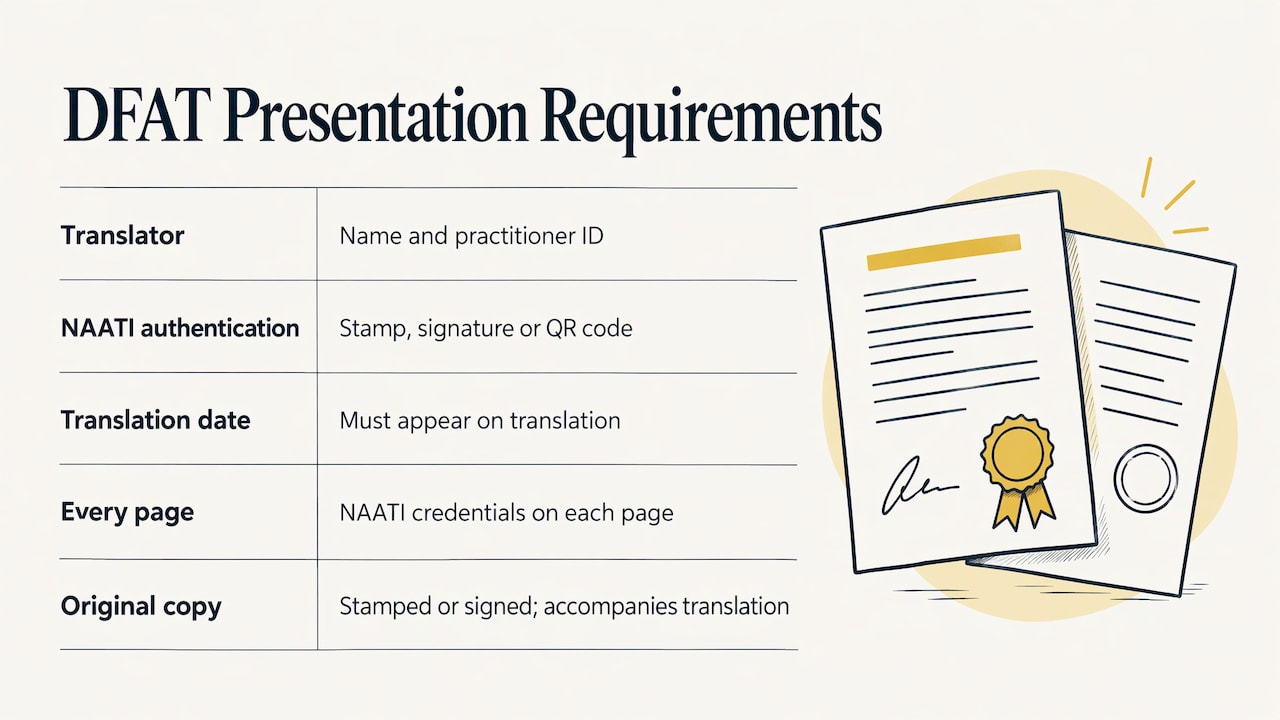
If your translated financial document will be legalised for use overseas, DFAT applies stricter presentation rules. Smartraveller and NAATI’s DFAT guidance both say the translation must show the translator’s name and practitioner ID, the NAATI stamp and signature or QR code, and the translation date. The NAATI credential information has to appear on every translated page, and a stamped or signed copy of the original must accompany the translation. If you’re planning to legalise, tell your translator at the start so the pages are set up correctly.
Step by step: getting a financial document translated for official use
1. Find out exactly what the receiving body wants
Check the checklist for your application or request. Note whether it asks for a “certified translation”, a “NAATI translation” or something else, whether it wants the original or a certified copy alongside, and whether there’s a date limit on the document (many bodies want bank statements from the last three or six months).
This is where people lose time. They order a translation, then find out the officer wanted a different statement period, or the full document and not an excerpt.
2. Get clear, complete copies
Scan every page at good resolution, including blank-looking pages, back pages and any stamps. Cropped edges and faint print cause errors and queries. If a statement is an online download, use the full PDF rather than screenshots.
3. Send it to a NAATI-certified translator
Upload the document for a quote. For most documents, pricing is per word, and our certified translation starts from $0.12 per word. Tell us the purpose (visa, tax, regulator, university), the deadline and whether the document will go to DFAT. That shapes how the pages are laid out and stamped.
4. Review the translation before you lodge
Check names against your passport, account numbers, dates and totals. Names are the most common issue: a name transliterated one way on your passport and another in the translation can trigger questions. If you spot something, raise it before lodging, not after.
5. Lodge the translation with the original or a certified copy
Most bodies want the translation attached to the source document or a copy of it. Keep the file together and don’t separate pages.
Why accuracy and confidentiality matter more here
Financial documents carry account numbers, balances, employer details and sometimes tax file numbers. Two things follow.
Accuracy. Machine translation tools are tempting for a 40-page statement. The NSW Government’s Language Services Guidelines warn that automated tools can be inaccurate because they miss idioms, dialect variation, tone and nuance. In a financial document, one wrong term or number can lead to a rejected application or a request for more information. A certified translator takes responsibility for the result, and the certification statement is the proof.
Confidentiality. NAATI-certified translators work under a code of ethics that includes confidentiality. NAATI’s own recertification guidance tells practitioners to remove identifying client information from supporting records and not to submit completed translations as evidence, because that would conflict with those ethics. We treat confidentiality as a core part of how we work, which matters when your documents show your whole financial picture.
Common mistakes that get documents knocked back
- Translating only part of a document. Summaries and excerpts are rarely accepted. Translate the whole thing.
- Using the wrong type of translation. A standard translation is fine for your own understanding or internal use. Anything lodged with an authority generally needs certification.
- Missing stamps and seals. If the original has a bank stamp, the translation should note it.
- Inconsistent names. Keep spellings consistent across every document in the same application.
- Old statements. The translation doesn’t fix a document that’s out of date for the application.
- Forgetting DFAT rules. If you plan to legalise, ask for the credential details on every page from the start.
How we can help
Stellar Translations provides NAATI-certified translation for official use across Australia, and standard translation for documents that don’t need certification. Our translators cover over 170 languages, with specialised experience in legal and technical documents, and we focus on fast turnaround and confidentiality. Certified translation starts from $0.12 per word and standard translation from $0.08 per word, billed per word, with additional charges for certified or urgent work.
If you’re lodging financial documents in Melbourne or anywhere else in Australia, send us the files and the name of the authority that asked for them. You can see the services on our homepage or read about NAATI translation in Melbourne.
Who this is useful for
Individuals applying for visas, citizenship or a home loan usually need bank statements, payslips and tax records translated, and want the right certification the first time.
Legal professionals need translations that hold up when a financial document is evidence in a matter. Matching terminology across a whole bundle matters, and so does a clear certification statement on each document.
Businesses expanding into Australia often have to translate annual accounts, audit reports and registration documents for regulators like ASIC. These are technical, and the translator needs to handle accounting terms across jurisdictions.
Students applying to institutions abroad, or to Australian providers from overseas, are often asked to show proof of funds. Statements and sponsor letters are the typical items.
FAQ
Do I need a certified translation of my bank statements?
If you’re lodging them with an Australian authority, usually yes. Many visa and regulatory processes ask for an English translation certified by a NAATI-accredited translator. Some bodies make exceptions, so check the checklist for your specific application.
What is the difference between a certified and a standard translation?
A certified translation is done by a NAATI-credentialed translator, who adds their name, stamp and a certification statement. A standard translation has no certification and is suited to your own reference or internal use. Authorities generally ask for the certified kind.
How much does a certified financial translation cost?
Our certified translation starts from $0.12 per word, and standard translation from $0.08 per word. The final cost depends on word count, language pair and deadline, with additional charges for urgent work. Upload your document for a quote based on the actual file.
Can I use Google Translate for financial statements?
Not for anything you’re lodging officially. Government guidance warns that automated tools can miss nuance and be inaccurate, and an authority wanting a certified translation won’t accept uncertified output. A NAATI-certified translator takes responsibility for the final text.
Does the translation need to be legalised?
Only if the document will be used overseas and the receiving country requires it. Legalisation is done by DFAT after the translation. If you need it, tell your translator first so the credential details appear on every page, as DFAT requires.