
If you need a NAATI translation in Melbourne, you need a translator who holds a current NAATI credential and who will stamp the English version of your document so an Australian authority accepts it. You do not have to find someone in your suburb. You do have to check the credential, confirm what the receiving agency wants, and brief the translator properly. This guide covers each step, from who needs certified translations to what drives the price.
TL;DR
- NAATI is Australia’s national certifying authority for translators and interpreters, and its credentials are valid across the country, so Melbourne residents can use a translator anywhere in Australia.
- Check any translator in the NAATI online directory using their Certified Practitioner Number (CPN) or the QR code on a digital stamp.
- Immigration, passport, Births, Deaths and Marriages and driver licence processes often ask for NAATI translations, but each agency sets its own rules, so confirm before you order.
- There is no standard industry rate. Cost depends on document type, language pair, formatting and deadline, so compare quotes.
- Stellar Translations offers NAATI-certified translation, with certified work from $0.12 per word.
Table of Contents
- What a NAATI translation actually is
- How to check a translator is certified for your language
- Do you need a translator in Melbourne?
- Which documents commonly need a NAATI translation
- What affects cost and turnaround
- Our perspective
- Ordering a NAATI translation from us
- A short checklist before you send documents
- If you are in Perth or elsewhere
- Language-specific questions, such as Spanish
- FAQ
- Sources
What a NAATI translation actually is
NAATI is the national standards and certifying authority for translators and interpreters in Australia, as described on its certification system page. A “NAATI translation” is a translation carried out, signed and stamped by a practitioner who holds a NAATI credential in that language pair. It is not a product of a company. The credential belongs to the individual translator.
Two details matter in practice:
- Credentials expire. Every NAATI credential has to be recertified every three years, and practitioners do that by showing they have kept up their skills and language through ongoing professional development, according to NAATI.
- Practitioners can be identified. Certified practitioners receive a 9-character Certified Practitioner Number (CPN) and may use a physical or digital stamp to show their credentials, per NAATI’s practitioner identification page.
The stamp and the CPN are what the receiving agency looks for. A translation without them is, for most official purposes, just a translation.
How to check a translator is certified for your language
Before paying anyone, verify. It takes a couple of minutes.
- Ask for the translator’s CPN, or look for it on a previous stamped document.
- Enter the CPN in the NAATI online directory. NAATI says clients can verify a practitioner’s credentials this way, or by scanning the QR code on a digital translator stamp.
- Confirm the credential covers your language pair and direction, for example Spanish into English.
- Check the credential is current. NAATI’s FAQ says the public directory lists practitioners who hold a NAATI credential and shows the highest credentials first.
The QR code on a digital stamp is unique to the day it is generated, according to NAATI, so a screenshot of an old stamp is not proof of anything. Scan the code on the document you actually receive.
The directory also lets you filter by language, location and certification type. That is useful if you want a Spanish, Mandarin, Vietnamese or Arabic specialist, or if you want a practitioner in a particular city.
Do you need a translator in Melbourne?
Most people searching for a NAATI translator “near me” assume they must visit someone. You usually do not. NAATI’s own guide says it is not necessary to use a translator based in your immediate area, because most translators accept jobs by email and NAATI credentials are the same throughout Australia.
That means a Melbourne resident can scan their documents, send them through, and receive a stamped translation back. It also means the same applies in Perth or any other city. If you want the original documents seen in person, or you need an interpreter rather than a translator, say so when you enquire. A translation turns written text into written text. Interpreting is spoken, and is a different service with different credentials and booking needs.
What matters more than location is fit: the right language pair, a current credential, experience with your document type, and a clear quote.
Which documents commonly need a NAATI translation
No single rule covers every document. Each agency decides what it accepts. These official pages show how common requests are worded:
| Purpose | What the agency says |
|---|---|
| Immigration (No Further Stay waiver request) | Documents not in English must come with NAATI-accredited English translations |
| Victorian birth, death or marriage records | Applicants in Australia must use a NAATI translator for non-English supporting documents, per Births, Deaths and Marriages Victoria. Documents already in English and another language do not need translation |
| Australian passport | Non-English documents must be translated in full and stamped by an accredited translator |
| Victorian driver licence or learner permit | A non-English licence must be translated by a NAATI-accredited translator or an appropriate consulate in Australia, and a current International Driving Permit may also be acceptable |
Other everyday examples include academic transcripts and degree certificates for university or professional registration, court and police documents, medical records, property contracts and business agreements. For those, the requirement comes from the institution, court or regulator asking for them, so read their instructions or ask them directly.
Confirm the requirement before you order
Three questions save most of the rework:
- Does the agency want a NAATI translation specifically, or is another translator acceptable?
- Must the whole document be translated, including stamps, handwriting and seals? The passport office, for instance, asks for translation in full.
- Does it want the original, a certified copy, or a scan attached to the translation?
If your document is already bilingual, check whether you need anything at all. Victoria’s registry says documents written in English and another language do not need translation.
What affects cost and turnaround
People ask how much a NAATI translator costs. The honest answer is that it depends, and no official price list exists. AUSIT, the professional association for translators and interpreters, says there is no standard Australian industry rate: practitioners set their own fees and conditions, so you should compare quotes from suitably qualified and experienced translators.
According to the same AUSIT FAQ, the factors that move a quote are:
- document size and type
- the language combination
- the amount of work involved
- formatting or desktop publishing
- subject matter
- the deadline
Legal, medical and technical work costs more, and urgent jobs usually attract a loading. AUSIT suggests allowing two to five working days for small jobs such as a marriage or birth certificate, and notes that productivity varies with formatting, complexity and whether the original is electronic. Good translators can be booked days or weeks ahead, so ask early.
How we price
We bill per word. Our published rates start from $0.12 per word for certified translation and from $0.08 per word for standard translation, listed on our FAQ page. The final quote depends on your document and deadline. We do not publish prices for legal, business, website or medical work, so for those we quote after seeing the file.
A practical way to compare quotes from any provider:
- Send the same clear scan to each one.
- Ask whether the quote includes the stamp, the certification statement and an electronic copy.
- Ask whether the price is per page, per word or per document, and what counts as a page.
- Ask what the rush surcharge is and when the delivery clock starts.
Cheap per-page offers can look attractive, but a flat page rate says little about a dense, small-print transcript compared with a short certificate. Per-word pricing is easier to reason about when your document varies in length.
Our perspective
We have been translating since 2000, and the same mistakes show up again and again. They are rarely about language. They are about the order of the process.
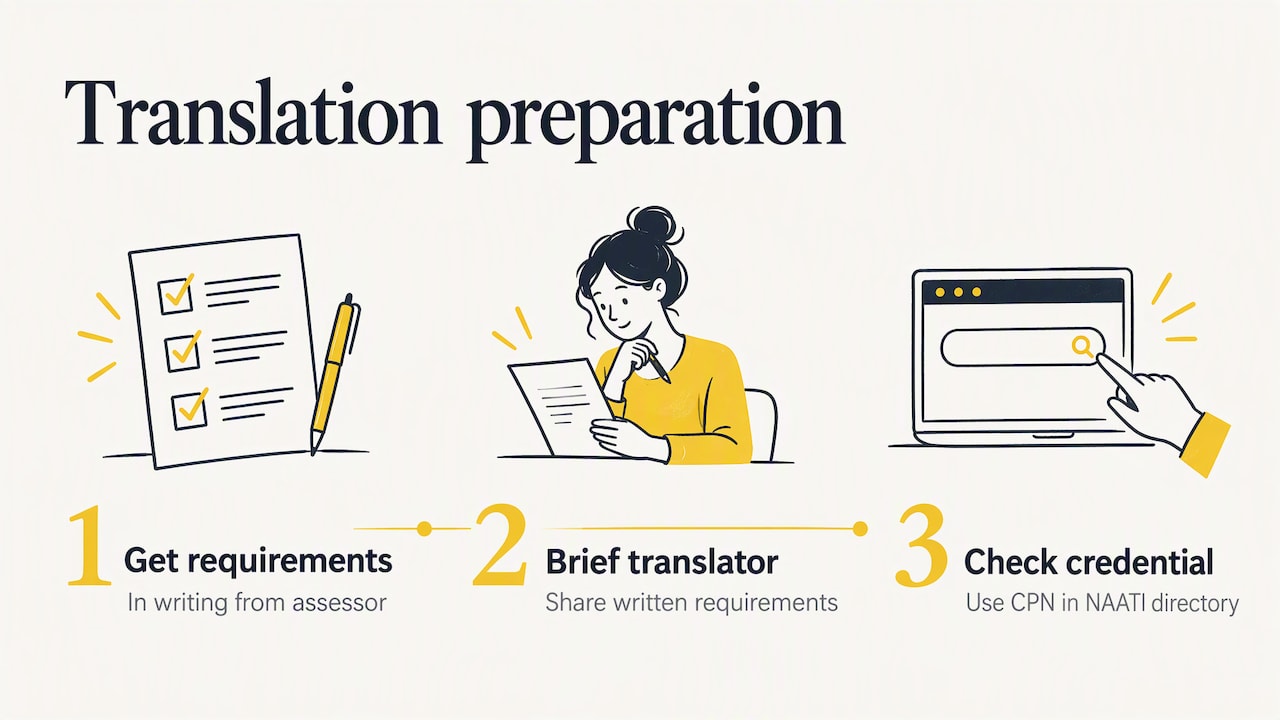
People translate first and ask the agency second. They then discover that the agency wanted full translation including stamps, or a different document set, and pay twice. Our advice: get the requirement in writing from the body that will assess your documents, then brief the translator with it.
The second mistake is treating NAATI certification as a badge a company wears. It is a personal credential held by the translator who signs your document. That is why we say the directory check is worth doing with any provider, us included. A credible translator will give you their CPN without fuss.
Third, quality is mostly about preparation. A sharp, complete scan, correct spelling of names as they appear in your passport, and a note on how each name should be rendered in English prevent the inconsistencies that cause an agency to query a document. If a certificate and a passport spell your name differently, tell us before we start, not after.
Last, legal and technical documents reward specialist knowledge. A contract, a court order or a clinical report uses terms that have a precise meaning in each legal system, and a literal rendering can mislead. That is where we put our most experienced translators, and why we ask for context on what the document is for.
— Matthew
Ordering a NAATI translation from us
We provide NAATI-certified translation for personal, legal, immigration, academic and business documents in over 170 languages, with fast turnaround options and strict confidentiality. Our NAATI-certified translation service is built for the documents Australian agencies ask about most: certificates, licences, transcripts, statements and legal papers.
For specialist work, see our pages for medical translation, or our legal, business and website translation services. If you need spoken rather than written language support, our interpreting services are described on our About page. Send a scan, tell us who the document is for and when you need it, and we will quote before any work starts.
A short checklist before you send documents
- Scan quality: Include every page, both sides, and any stamps or handwritten notes.
- Name spelling: Give the English spelling used on your passport.
- Purpose: Tell the translator which agency will receive the document and whether they have named a NAATI requirement.
- Deadline: Add your agency’s lodgement deadline, not just when you would like the translation.
- Delivery: Confirm whether you need a digital stamped copy, a hard copy, or both.
- Verification: Note the CPN and check it in the directory when the file arrives.
If you are in Perth or elsewhere
The same logic applies outside Victoria. Because NAATI credentials are national, a Perth resident can use a translator in any state. Local agencies still set their own rules. Western Australia’s transport department, for instance, says a non-English overseas licence from a non-recognised jurisdiction needs an English translation from an approved translator, which can include a NAATI-certified translator, with specific credential and date restrictions. Read the current page for your situation before you order.
Language-specific questions, such as Spanish
People often search by language, for example NAATI Spanish. The principle is the same for any language: look for a practitioner credentialed for that specific pair and direction, then verify them in the directory. Popular languages have many certified practitioners. Less common ones have few, which can lengthen the wait. If your language is rare, ask about timing at the start, and send the document early.
FAQ
How much does a NAATI translator cost?
There is no standard rate, and AUSIT says practitioners set their own fees. Cost depends on the document, language pair, formatting and deadline. Our certified translation starts from $0.12 per word, and we confirm a quote before starting.
Where can I find NAATI translation services in Melbourne?
You can search the NAATI online directory by language, location and certification type, or ask a provider for a translator’s CPN and check it there. Location rarely matters, since most translators work by email. You can also send your documents to us for a quote.
Are there NAATI-certified translators in Australia for every language?
Not for every language, though many languages are covered. Availability varies by language pair, and rarer languages have fewer practitioners. Search the directory for your language, or tell us what you need and we will confirm whether we can help and how long it will take.
Where can I find the cheapest NAATI translation?
Compare written quotes for the same document, since there is no fixed industry rate. Check what each includes: the stamp, the certification statement, electronic delivery and any rush loading. The lowest headline price is not always the lowest final cost, and a translation rejected by an agency costs you twice.
Do I always need a NAATI translation?
No. It depends on who is asking. Immigration, passports and some state registries request NAATI translations, while documents already in English may not need any. Check the agency’s current instructions before you order.
Sources
- NAATI certification system
- NAATI practitioner identification
- NAATI frequently asked questions
- NAATI guide to finding a translator or interpreter
- Home Affairs form 1447, No Further Stay waiver request
- Births, Deaths and Marriages Victoria, translated documents
- VicRoads, information in other languages
- Australian Passport Office, interpreting and translation
- Western Australia Department of Transport, non-recognised jurisdiction licences
- AUSIT frequently asked questions