A safety data sheet (SDS) translation has to carry every hazard, number and instruction across without changing its meaning, and in Australia it never replaces the English SDS. The English SDS is the compliant document. A translation is an addition for workers, suppliers or overseas partners who need to read it in another language. Choose a professional, accredited translator who knows occupational health and safety (OHS) terminology, and have the result reviewed. Don’t run it through machine translation.
This guide covers when you need a translation, what a good one preserves, how to check it, and what to do if you landed here looking for travel document translation.
TL;DR
- Australian rules call for an English SDS from the manufacturer or importer. A translation is an attachment and must be clearly marked as not part of the original SDS.
- Victoria’s WorkSafe guidance says complex OHS information should be translated by professional, accredited translators who know OHS terminology, and it says not to use machine translation.
- A good SDS translation keeps hazard statements, numbers, units, chemical names and dates exactly aligned with the source, and is reviewed again whenever the source changes.
- Travel and visa documents follow different rules: the receiving authority decides what translation it accepts, and NAATI-certified translators are the usual route in Australia.
- We translate in over 170 languages. Certified translation starts from $0.12 per word and standard translation from $0.08 per word.
Table of Contents
- When you need an SDS translated
- What an accurate SDS translation has to preserve
- How to check an SDS translation before it goes on site
- What SDS translation costs
- Perspective: how we approach safety data sheets
- Getting your SDS translated with us
- Travel document translation: a different set of rules
- Choosing a provider: criteria that matter
- FAQ
- Sources
When you need an SDS translated
Most Australian businesses never translate an SDS in the strict legal sense, because the duty to prepare it sits elsewhere. Under the Safe Work Australia code of practice on preparing safety data sheets, manufacturers and importers of hazardous chemicals must prepare an English SDS that meets Australian work health and safety requirements. Where a translation is attached, it must be clearly marked as not part of the original SDS.
In practice, translation comes up in a few situations:
- A workforce that reads limited English. A warehouse, kitchen, cleaning crew or farm may rely on staff who are safer with the hazard information in their first language.
- An importer receiving overseas paperwork. The supplier’s SDS arrives in Chinese, German, Korean or another language and you need to understand it before deciding what to do next.
- An exporter sending product abroad. Your English SDS has to reach distributors or regulators in another market.
- Procurement and compliance teams. They may need to understand a foreign-language SDS before the chemical enters a site.
The last case deserves a careful note. A translation of an overseas SDS does not turn it into an Australian one. The Safe Work Australia code expects the SDS to show a last reviewed date (or the prepared date if it has not been reviewed). It also expects the Australian manufacturer or importer’s name, address and business telephone number, plus an Australian business telephone number for emergency chemical information. A foreign SDS that lacks those items has a gap that translation cannot fill.
An Australian university guideline on requesting SDS translations when procuring chemicals shows the cautious approach. When an Australian vendor SDS is not available, it asks for one to be authored through a hazard information provider, then compared against the SDS originally requested to confirm the information is correct before use. If you are unsure which route applies to your chemical, ask your WHS adviser or your supplier first. Then order the translation for the people who need to read it.
What an accurate SDS translation has to preserve
An SDS is not prose. It is a structured document in a standard 16-section format, and each section has a job. A translator who treats it as ordinary technical writing will produce text that reads smoothly and is subtly wrong. The details below are the ones we check on every sheet.
Hazard classification and statements
Signal words, hazard statements and precautionary statements are controlled phrases. Their meaning is fixed, so the translation has to follow the established wording in the target language rather than a fresh paraphrase. If the source says a product “may cause” an effect, the translation must not soften it to “can sometimes” or harden it to “causes”. One changed qualifier can describe a different risk.
Numbers, units and limits
Concentrations, exposure limits, flash points, pH values, boiling points and quantities must match the source character for character. The translator also needs to handle decimal separators with care. Some languages use a comma where English uses a point, and a misread “0,5” or “0.5” is exactly the kind of error that survives a quick proofread. Units stay as written unless the client asks for a conversion and the conversion is noted.
Chemical identity
Product names, ingredient names and identifiers (such as CAS numbers) must not be translated loosely. Names follow the accepted nomenclature in the target language, and identifiers are copied exactly. Trade names usually stay in the original form.
First aid, firefighting and spill instructions
Sections that people read under stress need the simplest, clearest wording in the target language. Instructions have to stay in the same order and at the same level of urgency. A translator who reorders steps for style has changed the procedure.
Dates, versions and contact details
The revision date and version, the supplier’s details and the emergency number all carry through unchanged. If the SDS is updated, the translation is out of date until it is updated too. That is why translated copies need version control: the file name or header should show which source version the translation matches.
Layout and the “not part of the original” marking
A translation should follow the section numbering of the source so readers can compare the two side by side. When it is attached to an Australian SDS, label it clearly as a translation and not part of the original document, as the Safe Work Australia code requires.
How to check an SDS translation before it goes on site
WorkSafe Victoria’s compliance code on communicating OHS across languages gives a practical checklist. It says to use professional, accredited translators who are familiar with OHS, to have translations reviewed for accuracy, to update them when the source material changes, and to avoid machine translation. Turn that into a short process:
- Confirm the source is current. Check the revision date on the SDS before sending it. Translating an expired sheet only gives you an expired sheet in a second language.
- Brief the translator. Tell them the industry, the target audience (workers, regulators, customers) and the country where the translation will be read.
- Ask who is doing the work. You want a professional translator with technical and OHS experience in that language pair, not a generalist.
- Get a second-person review. For high-hazard chemicals, have a bilingual person who knows the chemical, such as a site supervisor or safety officer, read the translation against the source.
- Compare the controlled elements. Line up the hazard statements, numbers, units and emergency steps against the original. Anything that does not match goes back to the translator.
- Record the version. Store the translation with the source version it matches, and set a reminder to redo it when the SDS changes.
- Use it as an aid, not a replacement. Keep the English SDS as the compliant document and label the translation accordingly.
Why machine translation is the wrong shortcut
Free tools are tempting for a 16-section document with hundreds of technical phrases. The risk is that they sound confident when they are wrong, and nobody on the floor can tell. The WorkSafe Victoria guidance says not to use machine translation for this kind of information. The cost of a professional translation is small next to the cost of a worker misreading a handling instruction.
What SDS translation costs
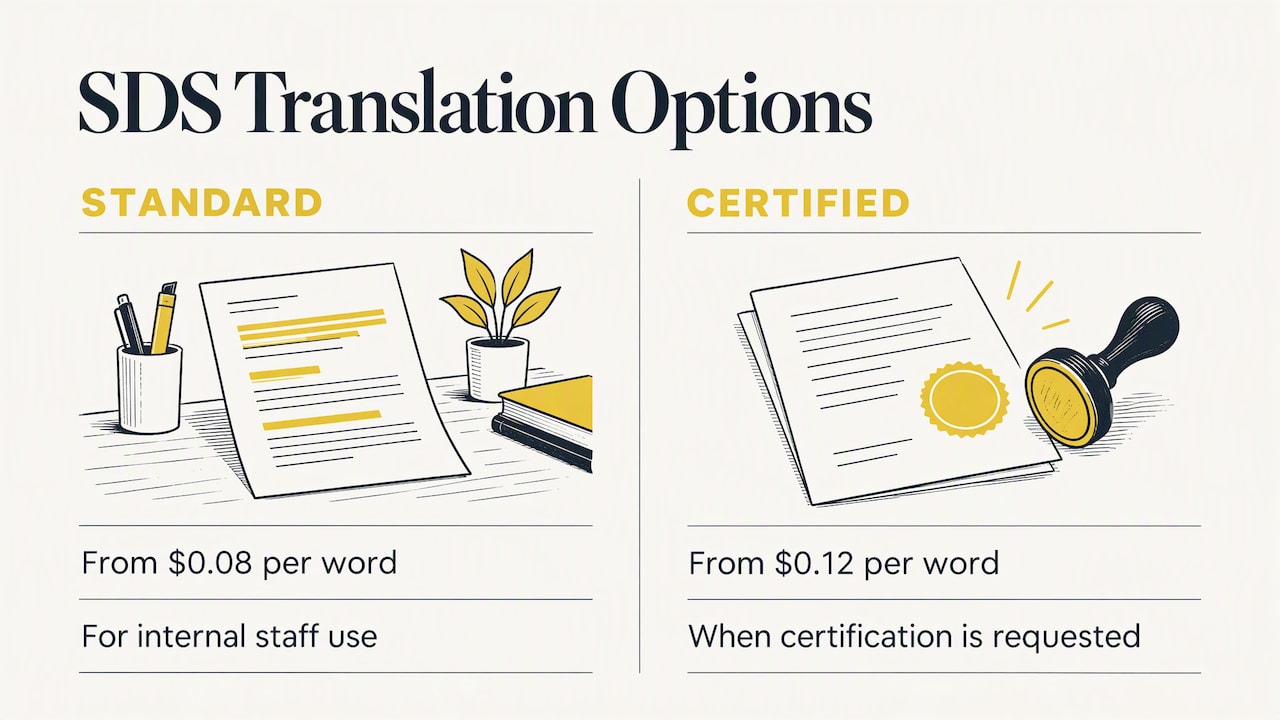
Translation is billed by the word, and SDS files are word-heavy but repetitive. Our published rates are from $0.12 per word for certified translation and from $0.08 per word for standard translation, as listed on our FAQ page. Which one applies depends on who will read the document. A standard translation suits internal use by your own staff. Certified translation is for when an authority, customer or contract asks for a certified document. Urgent turnaround carries an additional charge, so tell us your deadline when you ask for a quote.
Two things reduce cost and risk. Send the file in an editable format where you can, since scanned PDFs take longer to prepare. And send the whole product family at once, so related sheets with shared wording are translated consistently.
Perspective: how we approach safety data sheets
We have been translating since 2000, and the pattern with technical documents is the same every time: the errors that matter are rarely vocabulary errors. They are consistency errors. A hazard phrase translated two different ways on two sheets for the same product line, a decimal point that moved, a revision date that was not carried across.
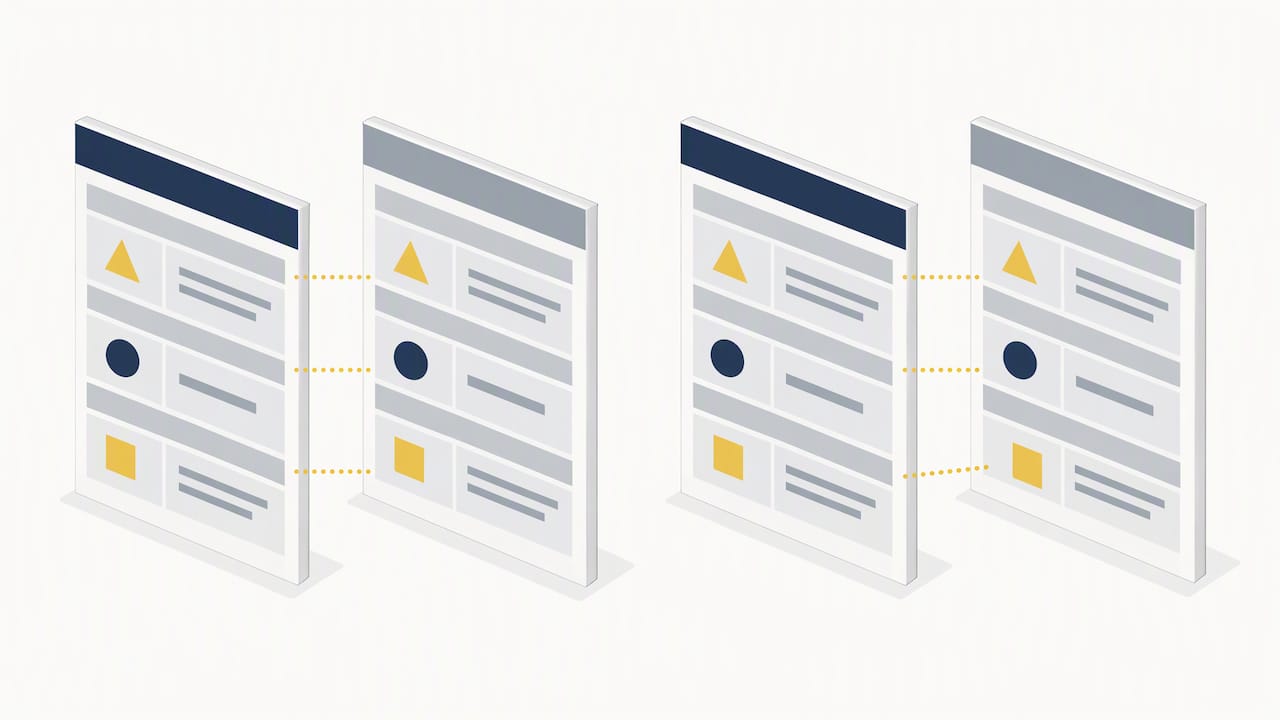
So we treat an SDS as a controlled document. The translator matches the section structure, keeps the numbers and identifiers exactly as they are, and follows established hazard wording rather than inventing new phrasing. If something in the source looks inconsistent or incomplete, we flag it to the client instead of quietly smoothing it over, because the owner of the SDS is the only one who can fix it.
We would also rather tell you what a translation cannot do. It cannot make an overseas SDS compliant in Australia, and it does not replace the English SDS prepared by the manufacturer or importer. What it can do is make sure the people who depend on that information can read it, accurately, in the language they think in.
— Matthew
Getting your SDS translated with us
We handle certified and standard translation of technical, legal and business documents in over 170 languages, with confidentiality and fast turnaround options. If you have an SDS to translate, send the file with the target language, the audience and your deadline, and we will quote it by word count. Our certified and standard translation options are set out on the FAQ page, and you can see the full range of services on the Stellar Translations homepage.
If the sheet is part of a wider legal or business project, such as a supply contract, import documentation or a compliance pack, we can translate the whole set so terminology stays consistent across documents.
Travel document translation: a different set of rules
People searching for SDS translation sometimes also need travel documents translated, so here is the short version. The difference is who sets the rules. For an SDS, the standard is safe, accurate hazard communication. For travel and visa paperwork, the receiving authority decides what it accepts.
Passport applications
The Australian Passport Office says non-English documents must be translated in full and stamped by an accredited translator. If you are in Australia, it points to NAATI as the place to find one. See the Passport Office guidance on translating foreign documents for the current wording.
Visa applications
For a visa application, the Department of Home Affairs sets the requirements. Its visitor visa guidance says that when a document is translated outside Australia, you need to provide the translator’s full name, address, phone number and qualifications in the language they are translating from. Always check the page for your specific visa, since requirements can differ between visa types.
Documents going overseas
If you need an Australian document legalised for use abroad, NAATI’s summary of DFAT translation requirements explains that NAATI certification lets DFAT treat a translator’s stamp or signature as an official certificate for an apostille, provided the required information is included. That information includes the NAATI stamp showing the practitioner ID, language and type of certification, the translator’s name, the date, and a signature or digital authentication.
A quick checklist for travel documents
- Ask the authority or embassy what it accepts before you order.
- Translate the whole document, including stamps, notes and seals.
- Use a NAATI-certified translator when the authority asks for an accredited or certified translation.
- Keep the original or certified copy ready, since the translation travels with the source document.
- Allow time, especially if you need an apostille afterwards.
Our NAATI-certified translation service covers personal, immigration and travel documents in Australia.
Choosing a provider: criteria that matter
Whether the job is an SDS or a visa document, the same questions separate a safe provider from a risky one.
| Question | What a good answer looks like |
|---|---|
| Who translates the document? | A named professional with experience in the subject and language pair |
| Is certification needed? | The provider asks where the document will be used and advises on NAATI certification if the authority needs it |
| How is accuracy checked? | A review step, and a process for corrections |
| How are updates handled? | Versions are tracked and retranslation is offered when the source changes |
| Is the file kept confidential? | A clear confidentiality commitment |
| Is pricing clear? | A per-word rate and a quote before work starts |
Be wary of any provider that promises instant, flawless output on a technical document without asking about the audience, or that does not mention review.
FAQ
Do I have to translate my SDS in Australia?
Not as a general rule. The Safe Work Australia code expects an English SDS from the manufacturer or importer. A translation is an optional addition, for example for staff who read another language, and it must be clearly marked as not part of the original SDS. If you are unsure about your obligations, ask your WHS adviser or your state or territory regulator.
Can I use free machine translation for a safety data sheet?
We advise against it. WorkSafe Victoria’s guidance says not to use machine translation for OHS information and recommends professional, accredited translators familiar with OHS terminology. A small error in a hazard phrase or a number can change the meaning of a safety instruction.
How often should a translated SDS be updated?
Whenever the source SDS changes. WorkSafe Victoria’s guidance says translations should be updated when the source material changes. Record the source version and revision date with each translation, so you know when it is out of date.
Does an SDS translation need to be NAATI certified?
The sources we reviewed do not make NAATI certification a requirement for an SDS translation. They call for professional, accredited translators who know OHS content. Certification matters more for documents such as passport, visa and legalisation paperwork. If a customer, contract or authority asks for certified translation, tell us at the start.
What do I need for a travel document translation?
First check what the receiving authority requires. For Australian passport applications, non-English documents must be translated in full and stamped by an accredited translator. For visas, Home Affairs asks for the translator’s details and qualifications when the translation is done outside Australia. We can advise on the right certification once you tell us where the document is going.
Sources
- Preparation of safety data sheets for hazardous chemicals (Safe Work Australia)
- Requesting SDS translation when procuring chemicals (Australian National University)
- Communicating occupational health and safety across languages (WorkSafe Victoria)
- Interpreting and translation (Australian Passport Office)
- Applying for a visitor visa (Department of Home Affairs)
- DFAT requirements for translators (NAATI)